“Where is Peter Fischer’s Rock?” asked an interested descendant early in my tenure as a Morrison historian of sorts, maybe about 1996. Answering questions was a key part of the job, but this one had me stumped. I’d never even heard of Peter Fischer, though I’m confident Morrison’s earlier historian, Lorene Horton, probably had. His early arrival and many contributions to the area qualify him for “pioneer” status. Why did he seem so little known, hardly remembered?
Peter’s story as adapted and abbreviated from a summary by his great-great-granddaughter Melanie Holmberg:
Peter Fischer, Morrison pioneer
Peter Fischer was born in Germany in 1826 and immigrated to Illinois in 1849 with his family (including parents, brothers, and sister). At age 33, he left the family farm in Illinois (and his wife Catherine) and moved alone to Cherry Creek in the spring of 1859, where he established a nursery business on the shores of Cherry Creek. Catherine joined him in 1860. In 1872 (before the railroad line to Morrison was completed), Peter, Catherine and 6-year-old Clara Fischer moved to Morrison, perhaps because he’d heard about the coming railroad.
After Peter moved to Morrison he “engaged in improving his farm and experimenting on fish and is now in possession of a beautiful beer garden.”1 “Laurelei [also Lorelei] Park, near the mouth of the canon, is the favorite resort of the people of Morrison, and the surrounding country. Its proprietor, Mr. Peter Fischer, has spared neither pains or expense in fitting up a nice place for a summer resort, and seems to be reaping a rich reward for his enterprise.”2
Fischer’s Flume, constructed across Peter Fischer’s Rock “above” Morrison.
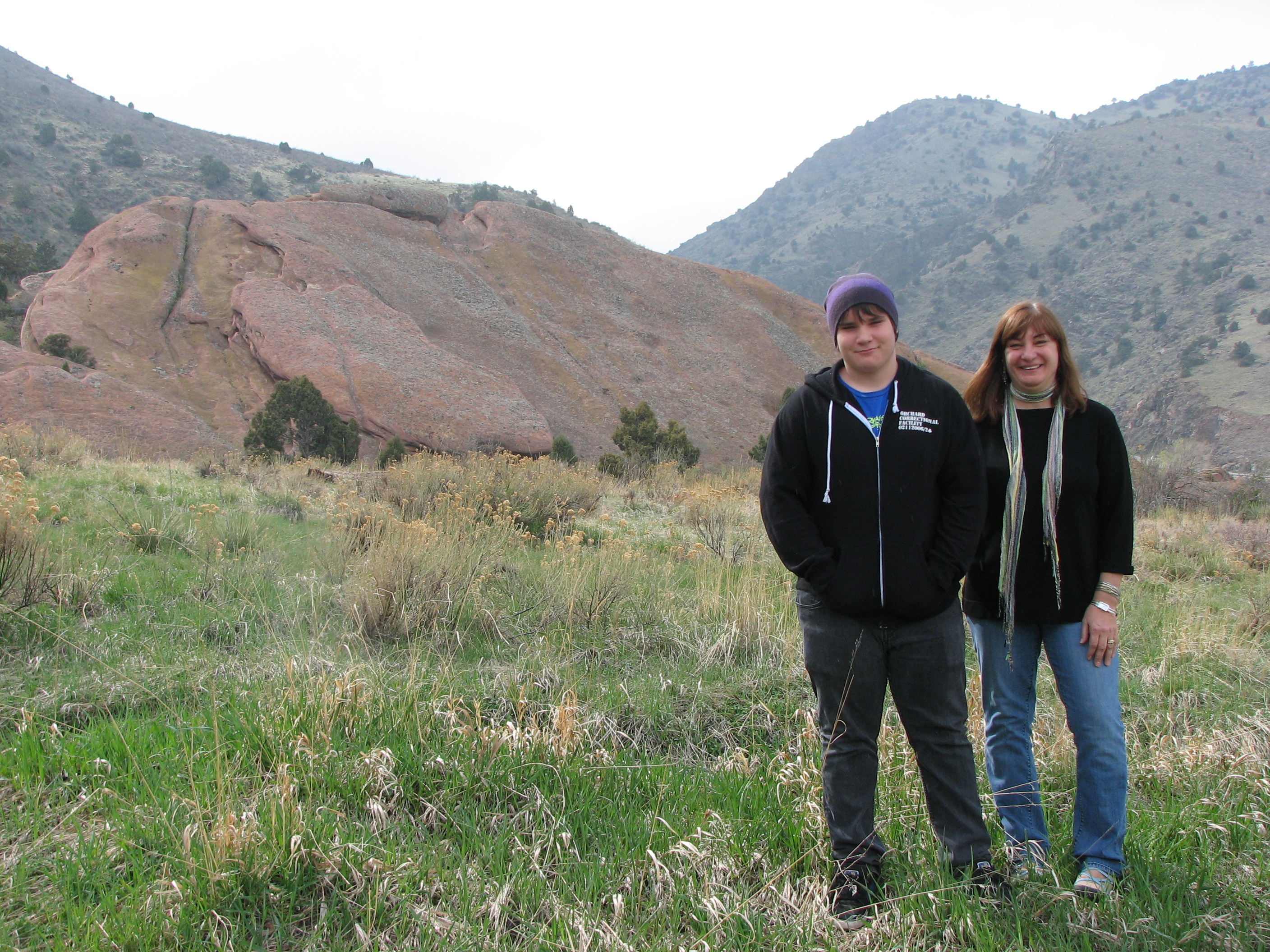
Peter may have owned land on “Fischer’s Mountain,” aka Mt. Fischer, now Mt. Falcon. He was also the owner of Fischer’s Ditch and Flume. “Fischer’s Rock,” or “Peter’s Rock,” is the large red sandstone outcrop overlooking Morrison on which he built Fischer’s Flume “to carry water around Mt Glennon to Turkey Creek.”3 He constructed two ponds, one to serve as a swimming pool and bathing area (for which he charged admission) and a lower one to water his livestock and farm (perhaps also for the above-referenced fishery).
After his daughter’s move to Denver and his second wife’s death, Peter suffered multiple financial setbacks and failures. He eventually left Morrison for Denver, impoverished, and was living in a “county home.” He apparently didn’t have a close (or any) relationship with his daughter and grandchildren. At his death, in 1900, he was reported to have dementia.
Melanie Holmbergwith son Tim, descendants of the Fischers, on a visit to Fischer’s Rock in 2010.
The story of the Fischer family is, of course, far more complex than this overview. Although Clara was the Fischers’ only surviving child, her marriage to Sabatino Tovani (another story) resulted in six children and an array of descendants.
The flume was short-lived and was therefore sometimes known as “Fischer’s Folly.” Evidence of its presence remains in faint traces on the landscape (see photo below).
Sources:
1 “Morrison Matters: A Word or Two About This Enterprising Foot-Hill Hamlet. Her Business, Agricultural and Grazing Facilities Commented On.” The Rocky Mountain News (Daily), Volume 25, April 27, 1884.
2 “Lively Morrison: A Rough Sunday’s Work—A Man Kicked to Death on Sunday—Notes of Business Progress and Social Gossip.” The Colorado Transcript, July 20, 1881
3 Kowald, Francis. “A Brief Historical Sketch and Some Reminiscences of The Sacred Heart College,” typed manuscript, circa 1935, housed in Archives and Special Collections, Regis University.
Aerial photo of Morrison area labeled showing approximate location of Fischer’s Flume.
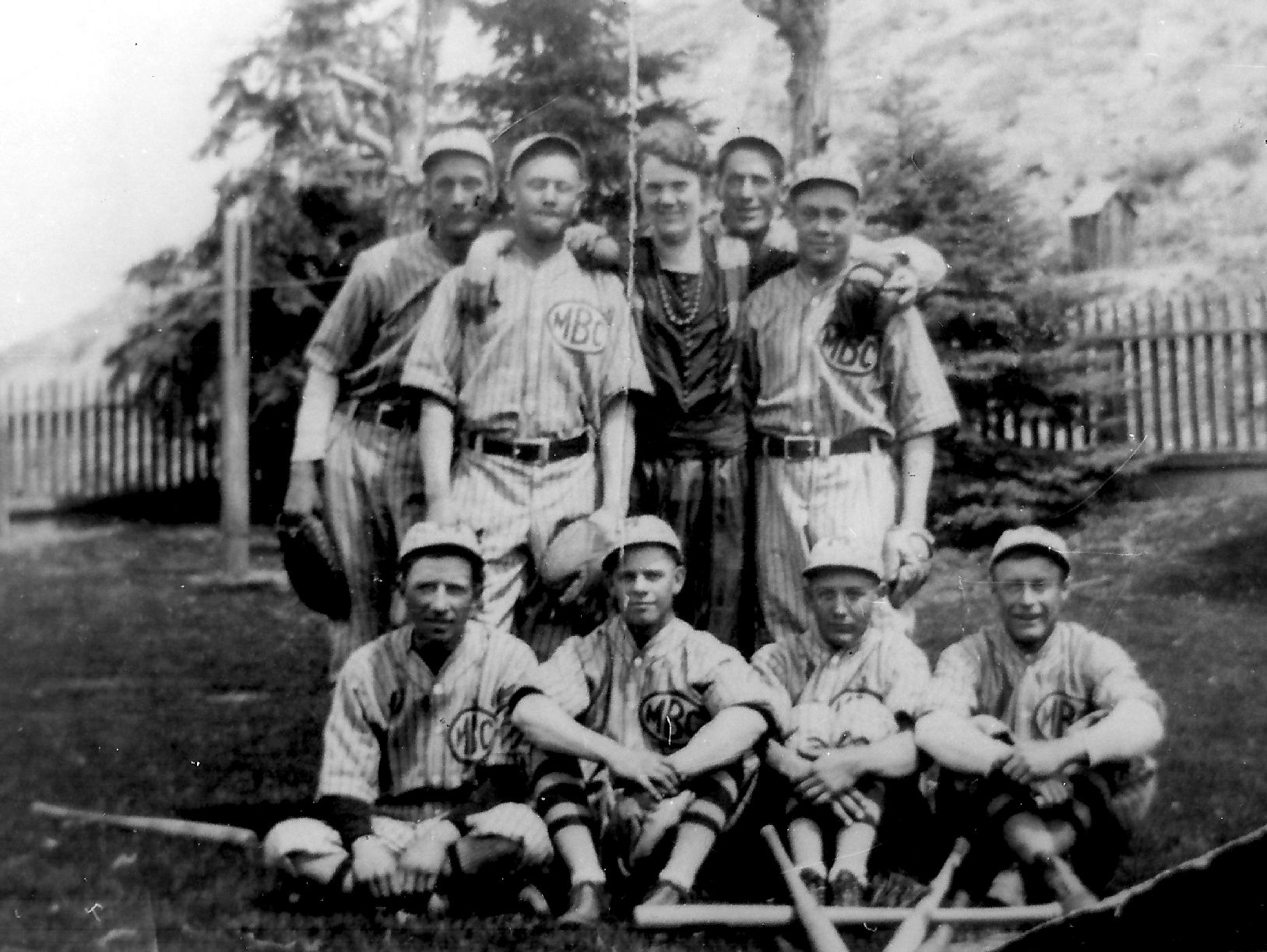
The Morrison baseball team, about 1915. Front row: Lawrence Knolls, Dan Schneider, Ted Schrock, Billie Sawyer. Standing: Henry Recks(?), Joe Schrock, Mrs. Kirby, Jim Groom, Tom Fleming.
Morrison fielded baseball teams regularly in the last century. The ballfield was east of town, where the wastewater management plant now stands. “Mrs. Kirby,” Lizzie C. Kirby (aka “Babe”), lived on Spring St. and served in Red Rock Circle No. 130 of the Women of Woodcraft in 1906 (Jeffco Graphic, 2/16/1906) and as a lecturer in the Bear Creek Valley Grange in 1912 (Arvada Sun, 1/19/1912).
Morrison Baseball Timeline
May 1902: Morrison Baseball Club (MBC) defeated Littleton 12 to 13(?). “The game was well played, close, and exciting.” Battery for Morrison included Nay, Evans, and Johnson; Littleton: Norton, Smith, and Bell. (RMN, 5/31/1902)
1908: “The Morrison Greys are showing fine form this year in scoring a 12 to 9 victory over the Twenty-first infantry team in a game at Morrison.” Howell and Boyd formed the winning battery. (RMN, 4/29/1908)
March 1910: “Morrison Reds will play any amateur team Sunday for expenses”; telephone D. Durham. (RMN, 3/26/1910)
May 1910: Morrison team defeats Manchester Athletic club, 12 to 6. (5/30/1910)
June 1910: Morrison wants a game for next Sunday. (RMN, 6/17/1910)
May 1927: Mt Morrison organizes a team; holds a dance to raise money for the “suits”
June 1927: “Morrison will entertain the Mines & Smelter team of Denver” Sunday. (RMN, 6/5/1927)
August 1930: Guy Hill team will play Morrison nine on Labor Day (Jeffco Rep, 8/28/1930)
Sept 1930, Golden Reds played Morrison in RR Park; Morrison won 8 to 4. (Jeffco Rep, 9/11/1930)
Mollie Dyer moved to Morrison July 3, 1902, when she married Otis Albert Pike. “That’s why we selected her,” Alex Rooney said in 1954 when she was elected Queen of Morrison’s Pioneer Days celebration. “Her husband is Morrison’s oldest surviving pioneer. She’s practically a native herself.” It only took her 52 years!
Born in Missouri Jan. 8, 1883, Mrs. Pike moved to Denver with her parents, Mr. and Mrs. Thomas Jefferson Dyer, in 1889. In 1900 she moved with her father to Cripple Creek, where he started a mercantile business. In Morrison she was active in town life and a community asset with many accomplishments to her credit. Mrs. Pike was a lifelong Democrat, the Rocky Mountain News reported, and served as superintendent of the Morrison Methodist Sunday School. She was also secretary of the school district 12 years and president of the school board four years, a leader in PTA, active in Red Cross and child welfare work, and a leader in salvage and war bond work in two World Wars. In 1954, she was named Queen of Morrison’s Pioneer Days event. For 35 years, she also wrote a column for Jefferson County weekly newspapers.
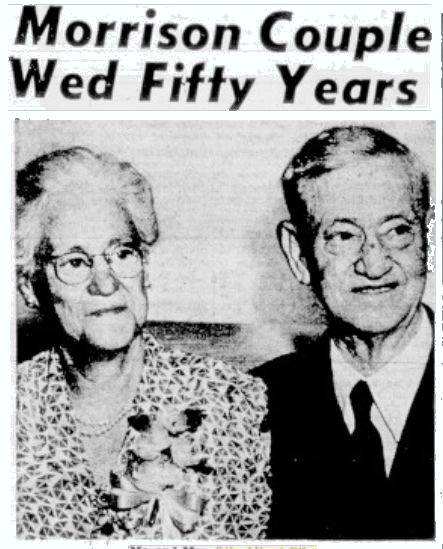
Mollie Dyer Pike and Otis Albert Pike on the occasion of their 50th wedding anniversary, July 1952.
Mollie’s husband, Otis Albert Pike (1877-1955), was a Morrison native and a grandnephew of Gen. Zebulon Montgomery Pike, for whom Pike’s Peak is named. His parents were Anderson Gage Pike (1830-1899) and Hannah Fenton Pike (1840-1887), pioneers who settled in Morrison sometime after 1864, leaving three children behind in Westview Cemetery in Kirkville, Iowa. Otis served the town as its Mayor for 14 years (circa 1930s) and owned the Pike and Perry Mercantile.
Otis and Mollie had three daughters, Esta Pike Burke (1903-1991) of New York City; Alberta Pike Boyd (1905-1975), owner of Denver’s Vogue Theater; and Genevieve Pike Moore (1907-1974), an employee of the Defense Department in Anchorage, Alaska. The Pikes are buried in the Morrison Cemetery; a nearby stone memorializes their daughters.
The Rocky Mountain News (Daily), Volume 95, Number 210, July 29, 1954; RMN, Volume 93, Number 188, July 6, 1952; RMN, Volume 96, Number 354, December 20, 1955.
Reader Luann commented on the “Deadly Duel” post to let us know about another historic murder in town. She writes:
Another illustrious story for consideration involves the shooting of my grandfather James William Hair by John Anderson at the pool hall in July of 1928. My grandfather was with the Secret Service so his shooting and all that followed was headline news.
Sgt. Leo, of the Morrison Police Dept., researched this one a few years back. Here’s the outline, but you can read his full story here (pdf), as reported in Morrison’s Hogback News, Sept 2018. The story was followed by area newspapers for months after the event.
Operative James Hair was engaged in an outdoor shooting match in downtown Morrison with James and Perry Knoll on July 12, 1928, when the men were approached by John Anderson, a bootlegger from Denver. Anderson was on parole at the time, on a charge of operating a still. He pulled a pistol and shot Hair in the chest, then disappeared into crowds emerging from local businesses. Anderson was captured and sentenced to life in prison. He was later granted a new trial and found guilty of manslaughter, with a one-year sentence. A later trial on the still charge added two years to his sentence. His wife Iris avoided being charged as an accomplice, and divorced him soon after.
Operative Hair was 34 at the time of his death, a University of Colorado graduate and World War I veteran who had joined the U.S. Secret Service two years earlier. He left a wife and two children.
Sgt. Leo was unable to pin down the location of a downtown shooting range, but it sounds as though it had to be near the town’s main intersection at Bear Creek Avenue and Stone St. The local businesses mentioned were Pike & Perry Mercantile (& dance hall) and Peinze’s Grocery Store, which occupied the two corners. Across the street was the large parking lot, formerly the railroad depot, used for various town activities. I’d guess any “outdoor shooting range” close to downtown would have to be in that area. Does anyone have better information? If so, please drop a comment below.
(Morrison pioneer justice, or Ned kills Ed kills Ned, 1879)
Morrison Pioneers to Have Their Say
“The old folks will get the opportunity they’ve been looking for -- a chance to have their say– at Morrison’s unique Pioneer Day celebration, July 30,” reported the Rocky Mountain News, July 17, 1949. Among the highlights of the event:
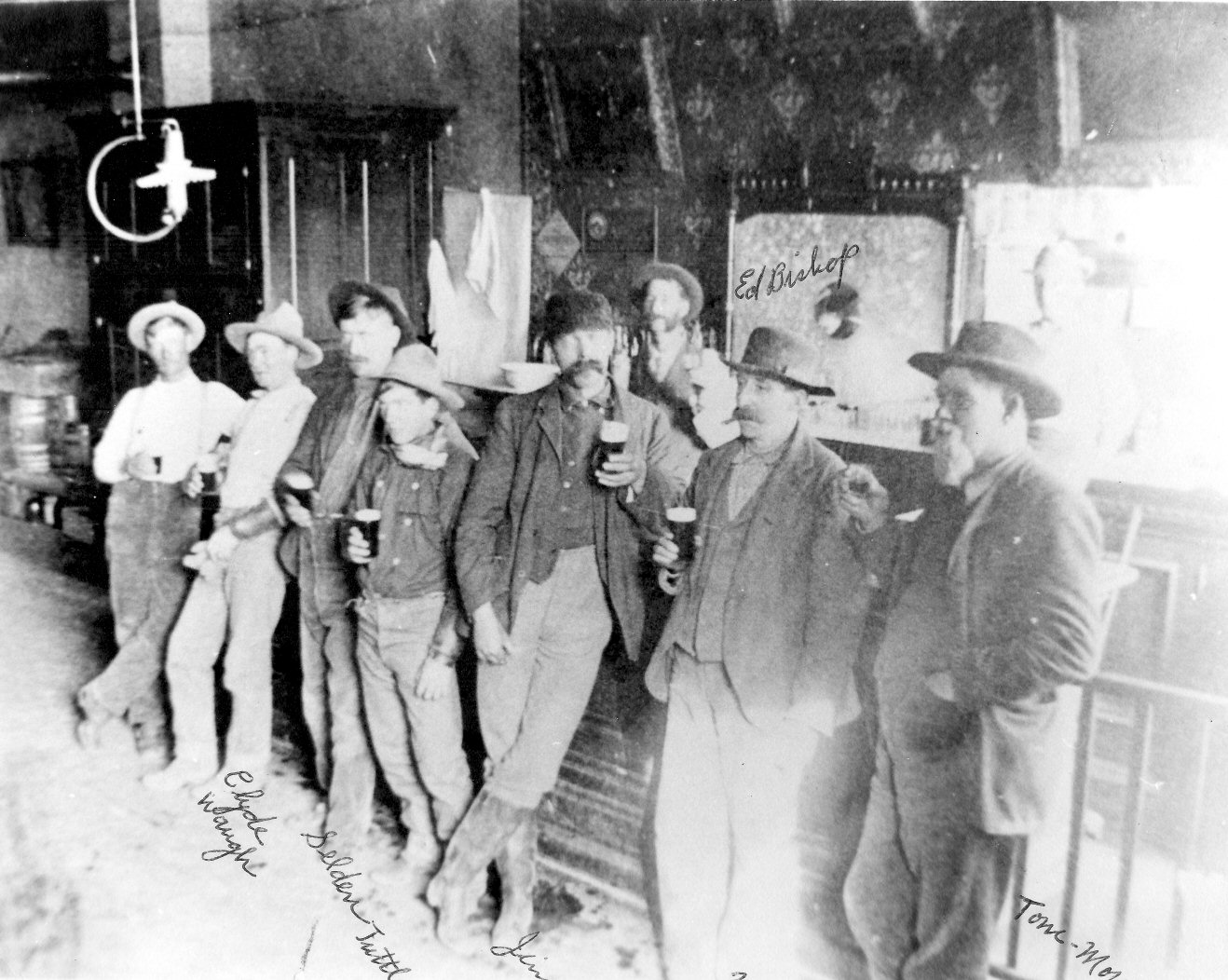
A quiet evening at the Schrock Saloon.
And there will be a dramatic story of the “Deadly Duel Fought in Morrison,” as newspaper headlines proclaimed. The duel took place in 1879 when Ed Sunderland was playing pool in Schrock’s Saloon at Morrison. Ned Pratt entered and started shooting out the lights, an exercise that caused Ed to descend upon him with a billiard cue.
One thing led to another, and Ned shot Ed twice in the forehead. The town marshall happily was close by and rushed in to charge Ned with murder.
But at that moment Ed raised himself on one knee, held his left hand over his wounds, and with his right hand sent a .45 caliber bullet crashing through Ned’s midsection. Ned died instantly, and Ed followed him 15 minutes later.
NOTE that above is a story passed down and written some 60+ years after the event. See comment below for links to “more accurate” accounts from the time, which was apparently 1885. Thanks, Joel…
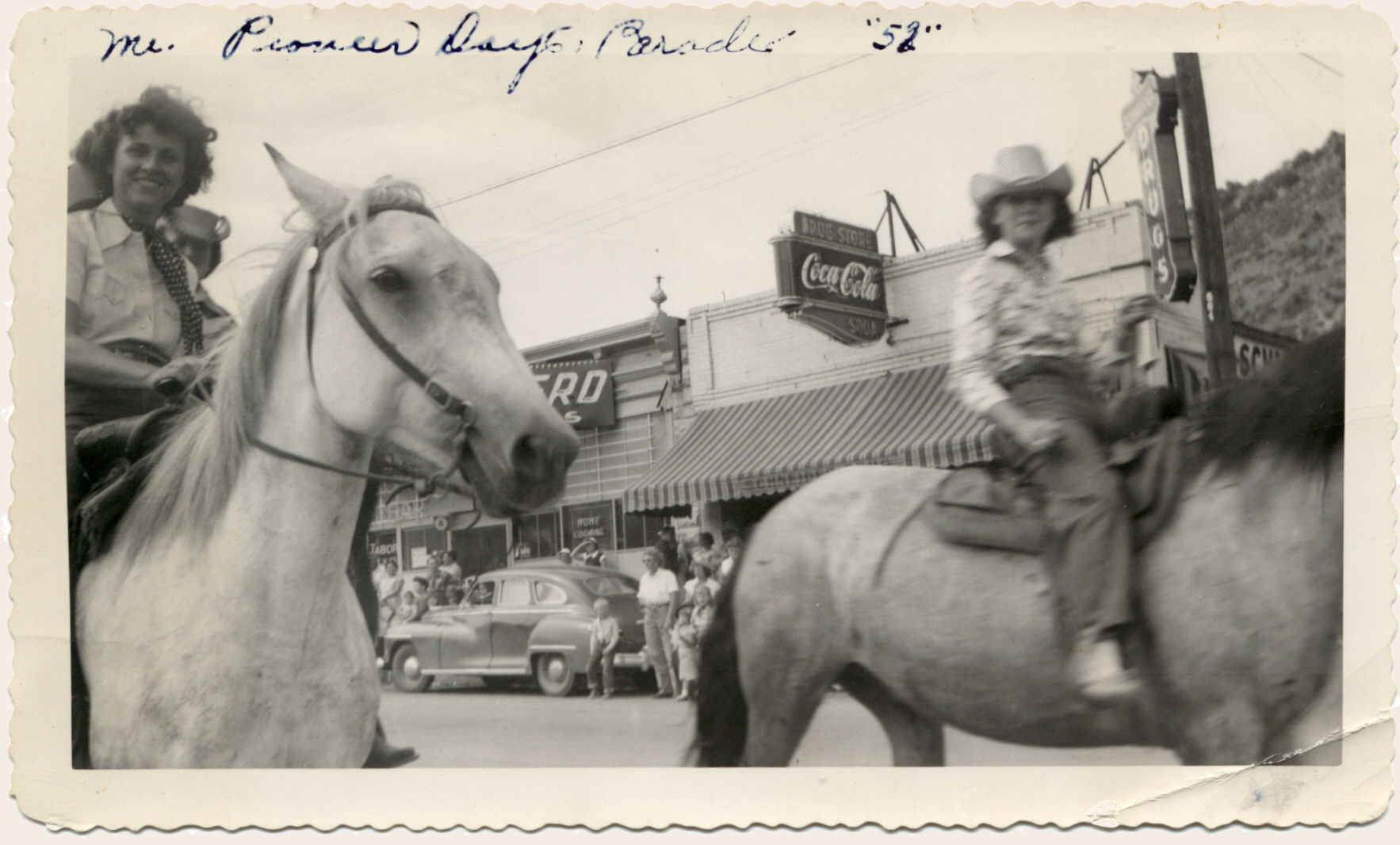
Pioneer Days were celebrated for more than a half-century in Morrison, and the parade down Bear Creek Avenue was especially popular. Stagecoach rides, showdowns, and visits to “jail” were other popular activities during the event.
Two young ladies riding in the Pioneer Days parade, 1952.
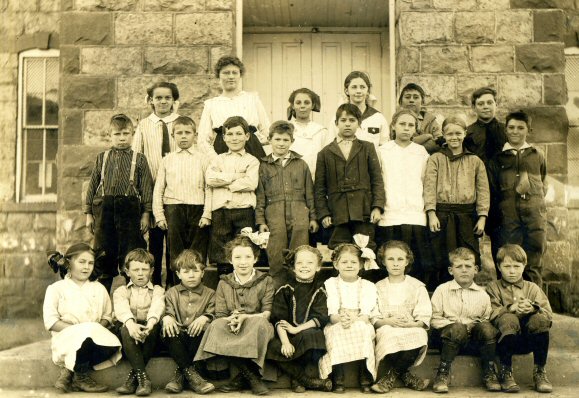
James E. Parsons, Sr., was in 5th grade at the Mt. Morrison school in about 1919. In the photo above, he is third from left in the center row. Parsons later worked for the Morrison Monitor, one of the town’s early newspapers.
A year earlier, 1918, perhaps with James Parsons in 4th grade.
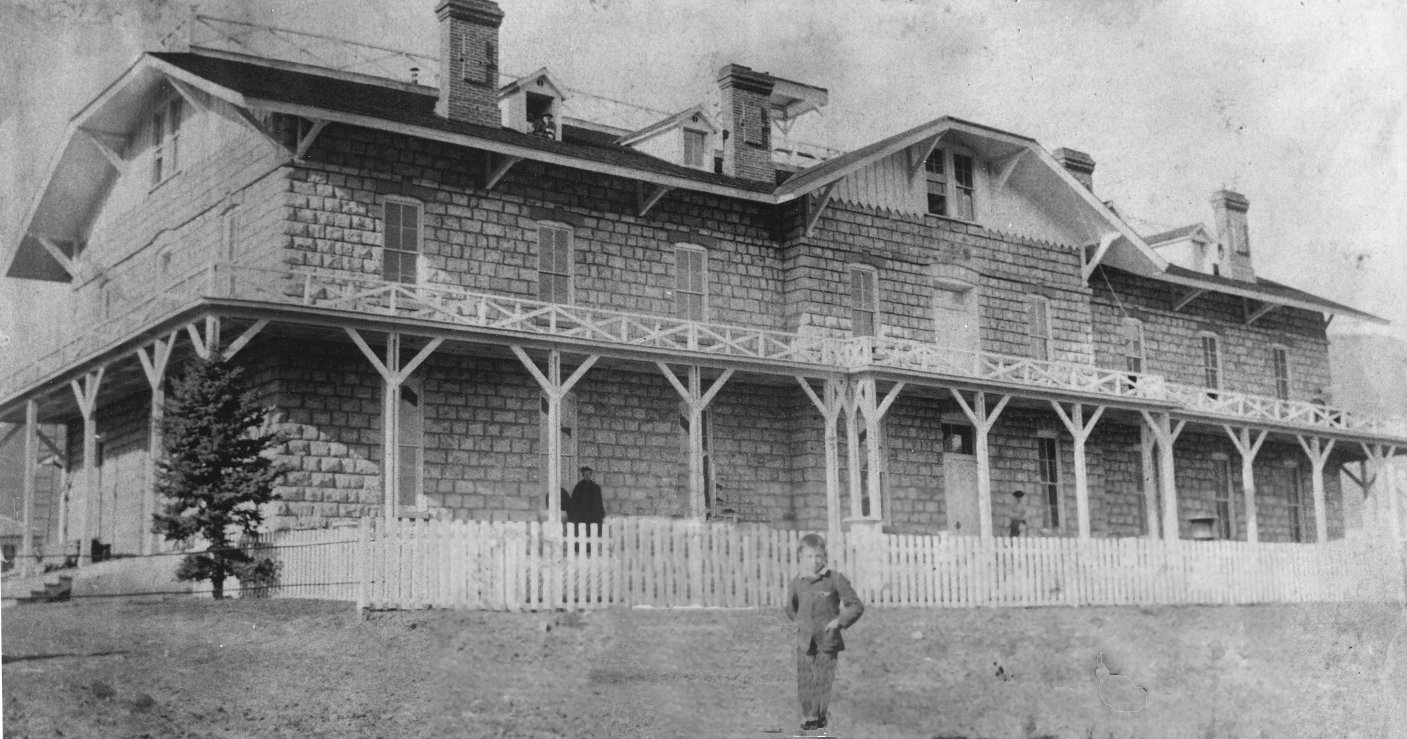
The Swiss Cottage, built by George Morrison for Governor Evans in 1874, was known by many names through the years.
That’s right, tiny Morrison was once a college town. For just four years, 1884-1888, Morrison was home to “Sacred Heart College,” really more of a prep school as some students were less than 14 years old. Originally founded by Jesuits in Las Vegas, New Mexico, the new Sacred Heart for Colorado opened in a former hotel building with just 24 students.
The building selected was one of Morrison’s dominant structures for nine decades. Known first as the Evergreen Hotel or the “Swiss Cottage,” the three-story building housed the students and their Jesuit instructors. A smaller building on the site provided servants’ quarters. By 1888, the remote location was deemed inconvenient, and the college moved to a new campus at Berkeley, close to Denver, and became Regis College (now University). A close friendship between the Jesuits and John Brisben Walker facilitated the trade, with Walker acquiring title to the Morrison location and renaming it the “Mt. Morrison Casino.” Read more about the Jesuits in Jefferson County here.
Its sandstone bulk loomed over the town’s skyline from 1874 to 1982, when it was demolished after a long and colorful history.
From a newspaper account of the events of July 24, 1896:
Friday evening the fierce black clouds in the west brought early darkness. A light rain drove the people into their houses, lamps were lighted, and the children were put to bed. Up town there were the usual loiterers in the stores and some stood by the open doors watching the rain fall. The air was calm and still and there was nothing to even indicate the change that was coming.
Suddenly a sullen roar, resembling thunder, yet more sustained, so that none mistook it for that noisy sound. Among those in the store, several had heard that sound before and knew its meaning. Their faces paled as they shouted, “A flood, a cloudburst!” Around the bend came the monster, appearing as a log-crowned curling wave ten feet high. It did not look like water, having more the appearance of a solid mass, dark as night, with a luminous crest.
It seems to move with almost lightening-like rapidity. When it reached the bridge above town, the first object that seemed to be in its path, there was no clash; the bridge hesitated but an instant, moved slowly from its piers, then went rolling end over end down past the depot until the railroad bridge was reached. Here there was a moment’s resistance, but the water simply paused to wait for reinforcements.
Following the 1896 flood, the Rocky Mountain News reported that
Less than two days ago Morrison was considered the most delightful, quiet and peaceful summer resort in Colorado. Today [July 26, 1896] it is a mass of wreckage and ruin, the people panic stricken and a number of those who were inhabitants are either lying at the morgue awaiting burial or are buried under an enormous mass of debris somewhere between Denver and Morrison, perhaps never to be found until Gabriel sounds the last trumpet on the day of judgement.
A day later, an update appeared: “Morrison Will Live”
The disastrous flood at Morrison has caused the active circulation of a rumor to the effect that the town would be abandoned by the people there. There is no reason or truth for the foundation of such a report. While Morrison has received a severe blow, she will recover promptly and there is not the slightest danger of a repetition of such a flood, for several years at least. …
This first-person account by Francis Kowald, S.J., describes one of many floods to strike in the lower reaches of Bear Creek Canyon and Morrison. Due to space constraints, it was not included in the 2014 issue of Historically Jeffco devoted to floods.
The writer of this short sketch happened to be an eye-witness of one of such frightful floods, which fortunately took place during the bright day-time. A cow-boy herald gallopped [sic] along at break-neck speed ahead of the swiftly on-rushing flood, some twenty minutes before its arrival and shouting at the top of his voice as he bounded along the road-bed, gave kindly warning, like another Paul Revere, to all residents housed on the banks or living close to the bed of the creek. They who were surprised and caught in the canyon itself during the storm, abandoning every kind of vehicle or truck they had, were obliged to scramble up the rugged mountain-sides, to save their own lives as well as their beasts of burden, if possible and time allowed in such an emergency.
Jesuits and students watched the flood described here from the porches of Sacred Heart College, as it was known from 1884-1888. This building, the Evergreen Hotel, later the Swiss Cottage, built by George Morrison for Governor Evans in 1874, was known by many names through the years.
This great flood occurred at the beginning of July during the third year vacation-days.(1) The lightning and thunder-storm had spent its fury and the sun appearing once more between the straggling clouds of the recently overcast and lowering sky, was again shining bright and peaceful. The creek was yet low, with scarcely one [foot] high running water in its bed, as we all at the College could notice, when upon the warning given, we had rushed to the porch to witness the terribly strange and ominous spectacle.(2) A few more moments of wild excitement and anxious dread and expectation, and behold! the onrushing torrent hove in sight. On its swollen crest of some three feet abrupt height, it carried the wreckage of some ten small wooden bridges, later rebuilt with reinforced cement, which had been erected for crossing and recrossing the creek along its nine mile circuitous course through Bear-Creek canyon from the village of Evergreen to the town of Morrison. Here it met the ponderous, twice planked wooden bridge, the largest of them all, about 30 ft. long and 10 ft. wide.(3) Here the torrent was arrested for a while in its impetuous course, not more than a minute or thereabout, in trepidation, as it were, of what it next would do, while it rose and swelled in size and piled up its ever augmented debris upon debris, until with a loud snapping and crashing of timbers like the report from a heavy gun, it bodily dislodged and lifted the entire bridge from its firm and heavy moorings and supports on either side and then with a mighty swirl turned and hurled it lengthwise like a huge arrow shot from a powerful bow with lightning speed down the fiercely raging and seething stream.
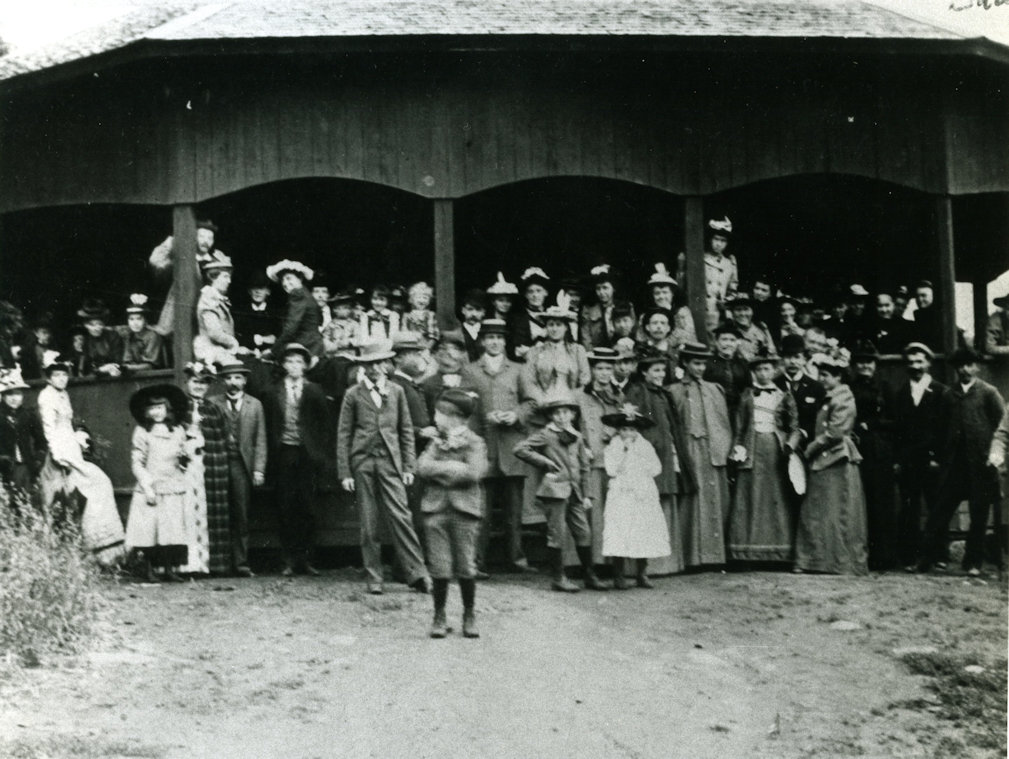
The Lorelei Park dance pavilion in downtown Morrison.
A moment later missing the Depot, it hit and demolished the wooden, octagonal, roof-covered Pavillion [sic], measuring some 15 ft. in diameter and some 12 ft. in height and built some 10 ft. above the creek, which was used as a grandstand for dancing, brass-band exhibitions and other amusements for the town-folk gathered together on certain festivals as Shrove Tuesday of carnival, Decoration-day, Fourth of July, All Hallows and the like, as it was centrally located in the town. With this accumulated wreckage the darting current nearly undermined the foundations of the adjacent Railroad Station and a few yards beyond carried away some 90 ft. of rail-road track with its steel rails still fastened to the ties or sleepers end at the first curve of turn tossed it out of the water and through the garret-floor and roof of a hut, inhabited by an elderly couple, without the least injury to their personal selves. It next spent its rage against the solid masonry and stone pillar-supports of the Railway-bridge across the creek near the gorge east of the town, loosened several flags, measuring 2 x 4 x 8 ft. and weighing tons apiece, and flung them yards away upon the banks below. After a good deal of further damage to cattle, hogs, poultry and a few horses, all of which were drowned in the lowland fields, it hurried along the plain, till finally it emptied or debouched into the South Platte River near Denver, some 16 miles distant toward the east. Fortunately no human lives were lost on this occasion, though a number of previous and subsequent cloudbursts claimed their sad toll of fatalities also among the lowland inhabitants along the banks of Bear-Creek.
Notes: (1) As the college started in the fall of 1884, we believe the “third year vacation-days” would indicate July 1887, assuming accurate recollection on the part of the author who was writing this account in about 1935. Except where noted in brackets, text and punctuation and spelling are as in the original version. (2) The large building housing Sacred Heart College from 1884 to 1888 sat on a bluff about 200 feet above the normal level of the creek. With few trees at that time to obstruct the view, it is likely that the observers had an excellent vantage point to observe this event. (3) This description likely refers to the bridge at South Park Avenue, which was the main route south of town toward Turkey Creek and, eventually, South Park.
Excerpted from (with paragraphing added): A BRIEF HISTORICAL SKETCH AND SOME REMINISCENCES OF The SACRED HEART COLLEGE Conducted by the Jesuit Fathers At Morrison, near Denver, Colorado From October 1884 till June 1888. From pages 11-13 of typed manuscript housed in Archives and Special Collections, Regis University.
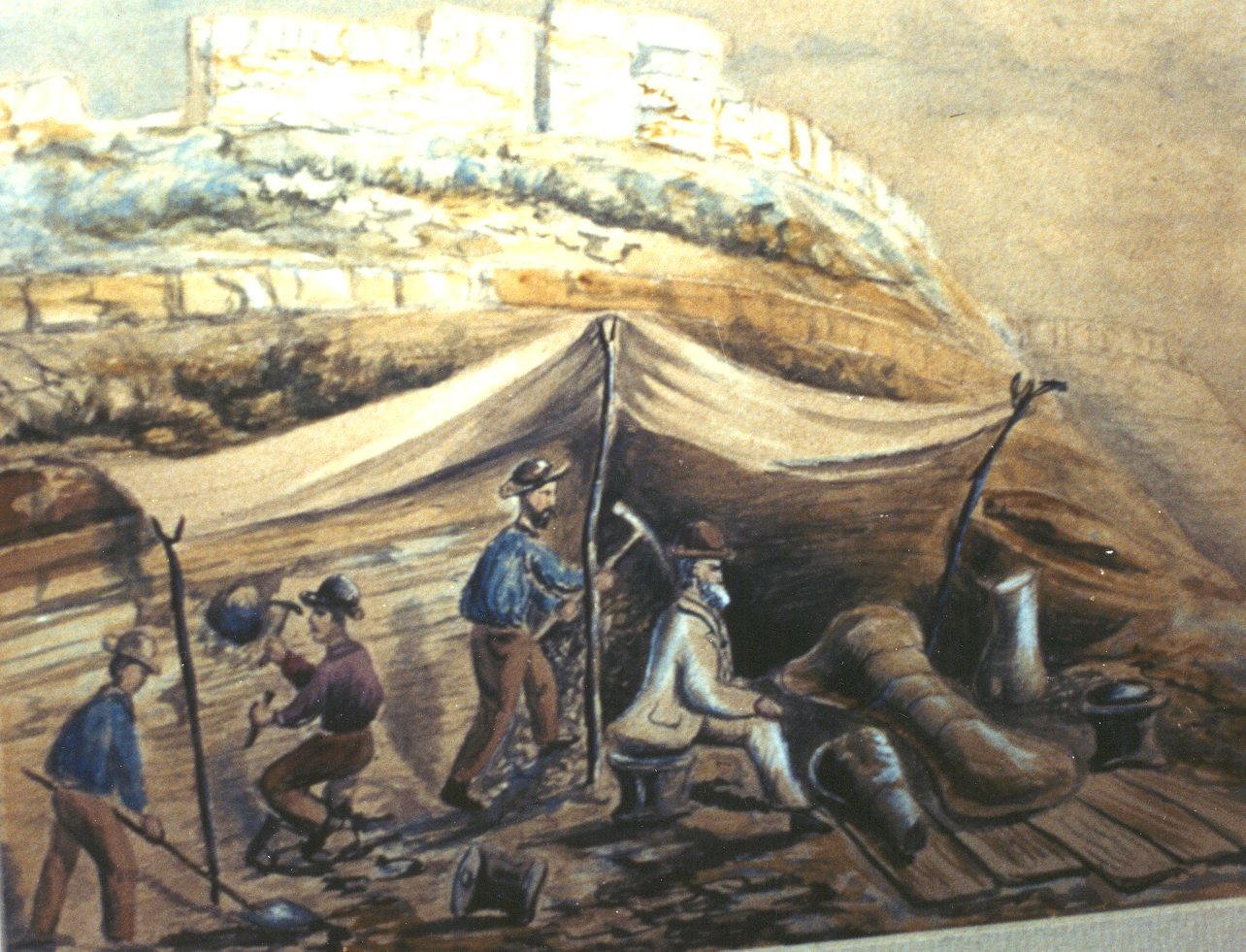
Quarry #10 near Morrison, or Clay Saurian #1, as drawn by Rev. Arthur Lakes.
One hundred forty years ago this month, Morrison entered the history of paleontology in an impressive way, with the discoveries made by Rev. Arthur Lakes on the hogback north of our small town.
On a Tuesday in late March 1877, a young professor made a discovery at what is now Dinosaur Ridge, near Morrison in Jefferson County, Colorado. This discovery transformed American geology and started a revolution in our understanding of dinosaurs. It also sparked a dinosaur “gold rush” that led the great scientific institutions of the East to turn their sights west. The fabulous wealth of such men as George Peabody, Andrew Carnegie, and Marshall Field was unleashed in a quest for the biggest and most bizarre dinosaurs to fill their museums. —Hunt, Lockley, & White, 2002
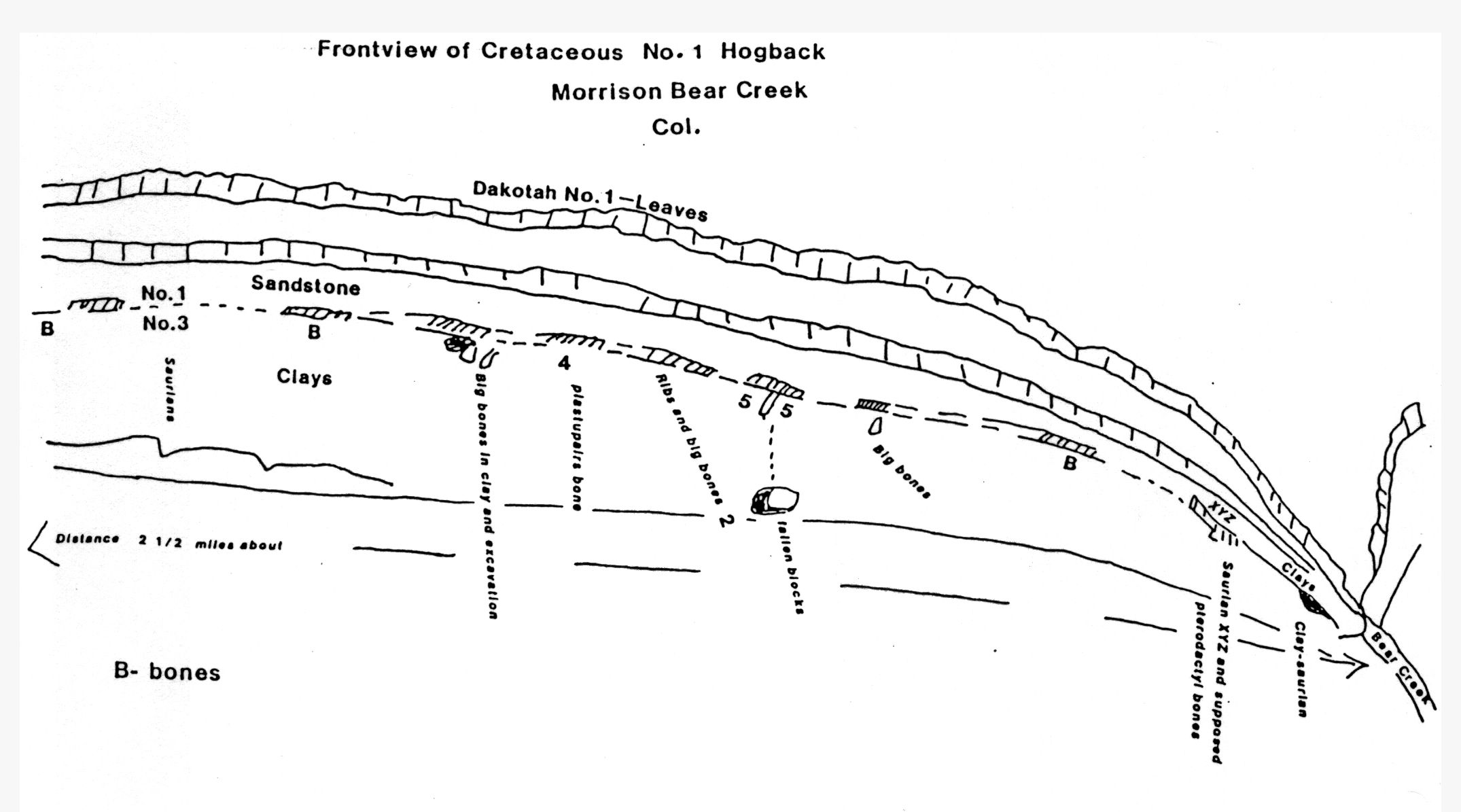
Arthur Lakes sketch of the quarries along the west slope of the Dakota hogback, from a letter to in 1879.
Ultimately, Lakes agreed to send the dinosaur bones discovered at Morrison to Professor O.C. Marsh at Yale’s Peabody Museum. For the next two years, Lakes and colleagues (including Benjamin Mudge, in white in above drawing) continued to send bones and reports to Marsh documenting their work at 14 sites along the hogback. Lakes also recorded their activities in his diaries, leaving us an extensive historical record of Morrison’s part in the “Bone Wars” of the late 19th century.
Lakes sent his first letter to Marsh on April 2nd, 1877. This letter told Marsh about the discoveries and their position in the sequence of rocks. He included good drawings of two partial bones and a detailed sketch of the geology of the area now known as Red Rocks Park and Dinosaur Ridge. —Hunt, Lockley, & White, 2002
Only four of the quarries yielded significant discoveries. Quarry #10, the Clay Saurian, is known for Apatosaurus ajax (YPM 1860). This site near the southern end of Dinosaur Ridge was relocated in 2002 and has been worked since then by teams from the Morrison Natural History Museum. Based on Lakes’s sketches of the hogback, his diaries, old photos, and field surveys, the location of Quarry #1 was identified in September of 2009 (Ghist & Simmons, 2010). The rediscovered quarry site was named a county landmark in 2014. This and other sites along Alameda Parkway are managed and interpreted by the Friends of Dinosaur Ridge.
National Natural Landmark Plaque on Dinosaur Ridge
The entire “Morrison Fossil Area” was named a National Natural Landmark in 1973. In 2011, the Landmark was expanded to include Late Cretaceous track sites near Golden, and is now called the “Morrison-Golden Fossil Area.”
Hunt, Adrian, Lockley, Martin and White, Sally. 2002. Historic Dinosaur Quarries of the Dinosaur Ridge Area Friends of Dinosaur Ridge and the University of Colorado at Denver Trackers Research Group.
More information on Morrison history is available at Jeffco Archives. Contact Archivist Ronda Frazier (rfrazier@jeffco.us) for access to the Morrison History Collection.





 Morrison History

