“Where is Peter Fischer’s Rock?” asked an interested descendant early in my tenure as a Morrison historian of sorts, maybe about 1996. Answering questions was a key part of the job, but this one had me stumped. I’d never even heard of Peter Fischer, though I’m confident Morrison’s earlier historian, Lorene Horton, probably had. His early arrival and many contributions to the area qualify him for “pioneer” status. Why did he seem so little known, hardly remembered?
Peter’s story as adapted and abbreviated from a summary by his great-great-granddaughter Melanie Holmberg:
Peter Fischer, Morrison pioneer
Peter Fischer was born in Germany in 1826 and immigrated to Illinois in 1849 with his family (including parents, brothers, and sister). At age 33, he left the family farm in Illinois (and his wife Catherine) and moved alone to Cherry Creek in the spring of 1859, where he established a nursery business on the shores of Cherry Creek. Catherine joined him in 1860. In 1872 (before the railroad line to Morrison was completed), Peter, Catherine and 6-year-old Clara Fischer moved to Morrison, perhaps because he’d heard about the coming railroad.
After Peter moved to Morrison he “engaged in improving his farm and experimenting on fish and is now in possession of a beautiful beer garden.”1 “Laurelei [also Lorelei] Park, near the mouth of the canon, is the favorite resort of the people of Morrison, and the surrounding country. Its proprietor, Mr. Peter Fischer, has spared neither pains or expense in fitting up a nice place for a summer resort, and seems to be reaping a rich reward for his enterprise.”2
Fischer’s Flume, constructed across Peter Fischer’s Rock “above” Morrison.
Peter may have owned land on “Fischer’s Mountain,” aka Mt. Fischer, now Mt. Falcon. He was also the owner of Fischer’s Ditch and Flume. “Fischer’s Rock,” or “Peter’s Rock,” is the large red sandstone outcrop overlooking Morrison on which he built Fischer’s Flume “to carry water around Mt Glennon to Turkey Creek.”3 He constructed two ponds, one to serve as a swimming pool and bathing area (for which he charged admission) and a lower one to water his livestock and farm (perhaps also for the above-referenced fishery).
After his daughter’s move to Denver and his second wife’s death, Peter suffered multiple financial setbacks and failures. He eventually left Morrison for Denver, impoverished, and was living in a “county home.” He apparently didn’t have a close (or any) relationship with his daughter and grandchildren. At his death, in 1900, he was reported to have dementia.
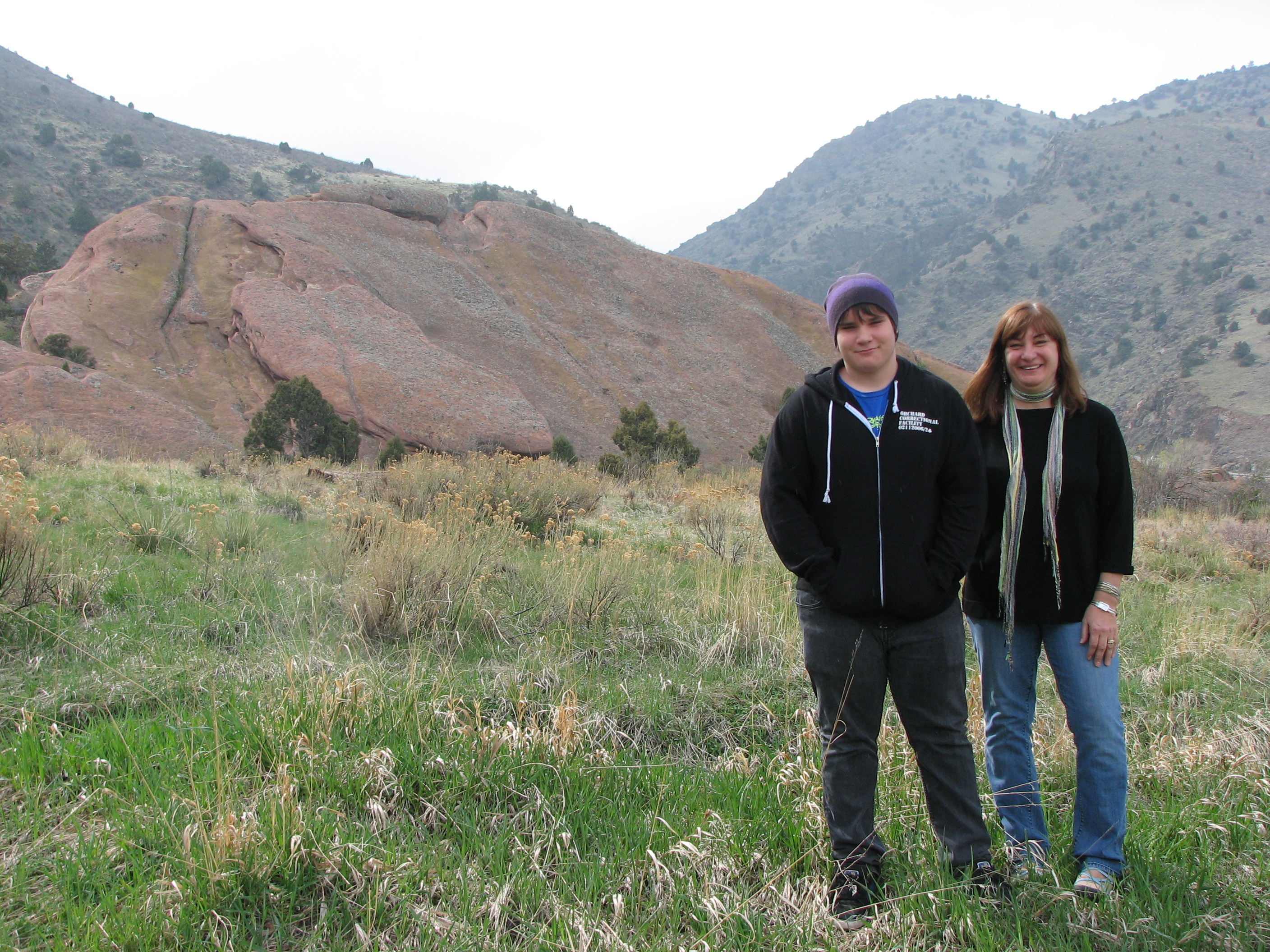
Melanie Holmbergwith son Tim, descendants of the Fischers, on a visit to Fischer’s Rock in 2010.
The story of the Fischer family is, of course, far more complex than this overview. Although Clara was the Fischers’ only surviving child, her marriage to Sabatino Tovani (another story) resulted in six children and an array of descendants.
The flume was short-lived and was therefore sometimes known as “Fischer’s Folly.” Evidence of its presence remains in faint traces on the landscape (see photo below).
Sources:
1 “Morrison Matters: A Word or Two About This Enterprising Foot-Hill Hamlet. Her Business, Agricultural and Grazing Facilities Commented On.” The Rocky Mountain News (Daily), Volume 25, April 27, 1884.
2 “Lively Morrison: A Rough Sunday’s Work—A Man Kicked to Death on Sunday—Notes of Business Progress and Social Gossip.” The Colorado Transcript, July 20, 1881
3 Kowald, Francis. “A Brief Historical Sketch and Some Reminiscences of The Sacred Heart College,” typed manuscript, circa 1935, housed in Archives and Special Collections, Regis University.
Aerial photo of Morrison area labeled showing approximate location of Fischer’s Flume.
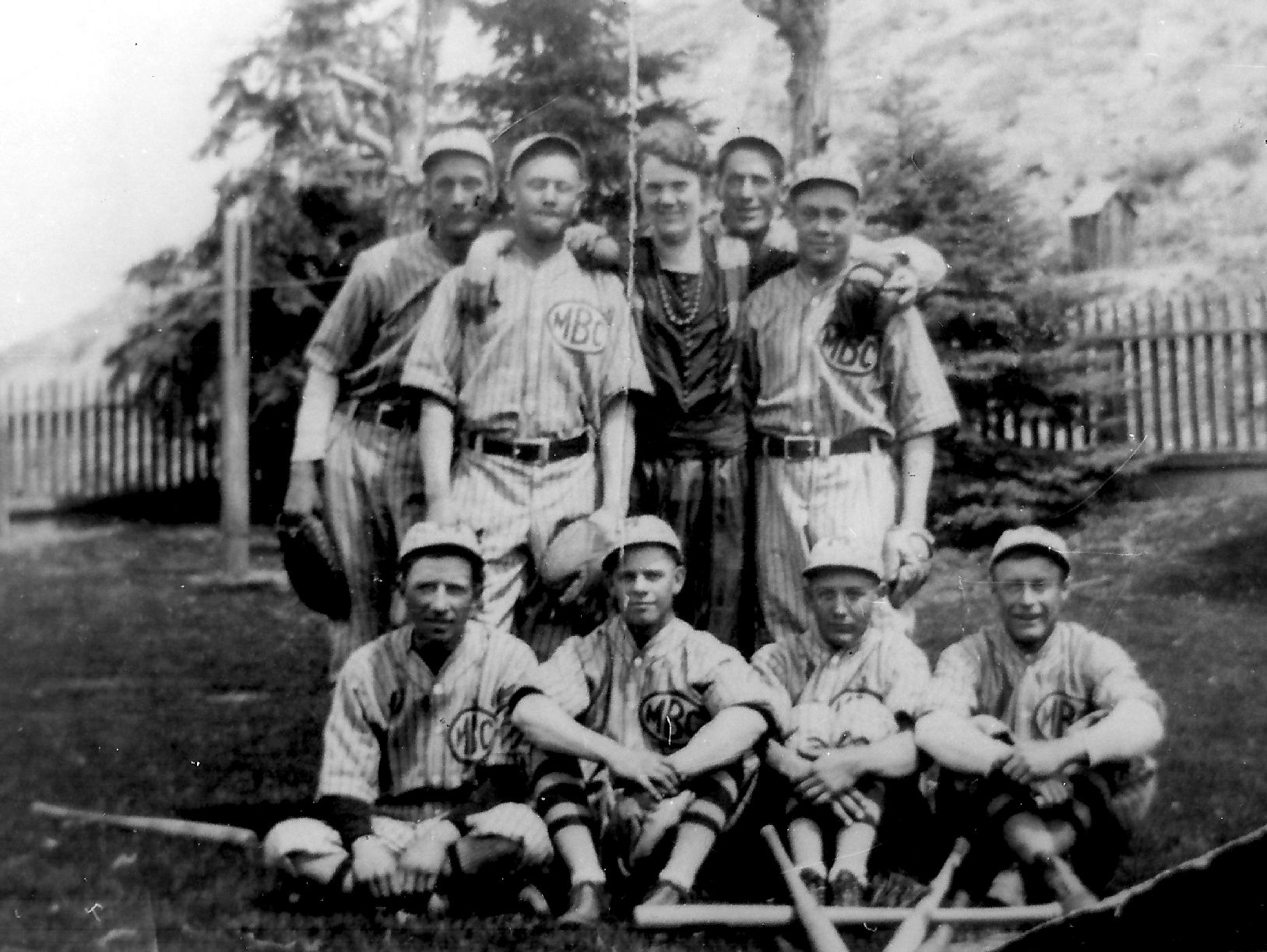
The Morrison baseball team, about 1915. Front row: Lawrence Knolls, Dan Schneider, Ted Schrock, Billie Sawyer. Standing: Henry Recks(?), Joe Schrock, Mrs. Kirby, Jim Groom, Tom Fleming.
Morrison fielded baseball teams regularly in the last century. The ballfield was east of town, where the wastewater management plant now stands. “Mrs. Kirby,” Lizzie C. Kirby (aka “Babe”), lived on Spring St. and served in Red Rock Circle No. 130 of the Women of Woodcraft in 1906 (Jeffco Graphic, 2/16/1906) and as a lecturer in the Bear Creek Valley Grange in 1912 (Arvada Sun, 1/19/1912).
Morrison Baseball Timeline
May 1902: Morrison Baseball Club (MBC) defeated Littleton 12 to 13(?). “The game was well played, close, and exciting.” Battery for Morrison included Nay, Evans, and Johnson; Littleton: Norton, Smith, and Bell. (RMN, 5/31/1902)
1908: “The Morrison Greys are showing fine form this year in scoring a 12 to 9 victory over the Twenty-first infantry team in a game at Morrison.” Howell and Boyd formed the winning battery. (RMN, 4/29/1908)
March 1910: “Morrison Reds will play any amateur team Sunday for expenses”; telephone D. Durham. (RMN, 3/26/1910)
May 1910: Morrison team defeats Manchester Athletic club, 12 to 6. (5/30/1910)
June 1910: Morrison wants a game for next Sunday. (RMN, 6/17/1910)
May 1927: Mt Morrison organizes a team; holds a dance to raise money for the “suits”
June 1927: “Morrison will entertain the Mines & Smelter team of Denver” Sunday. (RMN, 6/5/1927)
August 1930: Guy Hill team will play Morrison nine on Labor Day (Jeffco Rep, 8/28/1930)
Sept 1930, Golden Reds played Morrison in RR Park; Morrison won 8 to 4. (Jeffco Rep, 9/11/1930)
In “recent” decades (1990s on?), the town or entities within it have published newsletters to keep residents apprised of local happenings. These newsy notes also capture part of the evolution of desktop publishing since its early days in the 1980s.
Such wonderful little slices of modern history– we wish we’d kept more of these! Here are a few milestones, events, and general memories from a few issues at hand.
From Town Talk, September 1992:
The construction of the new fire station has begun east of town on Hwy 8. [Lakewood/Bancroft moved from today’s town office/police building to the new location and is now known as West Metro.]
Saturday, October 31st was scheduled to be Cider Days on the Bear Creek Nursing Center lawn, co-sponsored by the Morrison Action Committee and the Front Range Antique Power Association. Yes, there was a tractor show.
The town office staff solicited recipes from “All Ye Great Cooks” for the “Morrison Recipe Roundup Cookbook.” [Wonder what happened to that project.]
A Fireside Chat at the Morrison Natural History Museum featured town resident and USGS geologist Christine Turner speaking on the Paleoecology of the Morrison Formation. As of 2024, the Friends of Dinosaur Ridge were still hosting Fireside Chats.
From The Town Crier, #2, Jan-Feb 1999 “published as needed by the Morrison Action Committee”:
A “new Morrison tradition” was established when more than 100 people turned out December 4th to enjoy the festive atmosphere and holiday lights of downtown Morrison, while singing favorite songs of the season.
Pat Harrod, music teacher at Red Rocks Elementary School, and a band of his students led the chorus from the Morrison Community Church to the SunRise/Bear Creek Nursing Center.
At caroling stops along the way, business owners offered refreshments: spicy cider and cookies from Shari Curtis at Red Earth; roasted chestnuts with egg nog and coffee at Morrison Liquors; hot cocoa at the Horton House Bed and Breakfast.
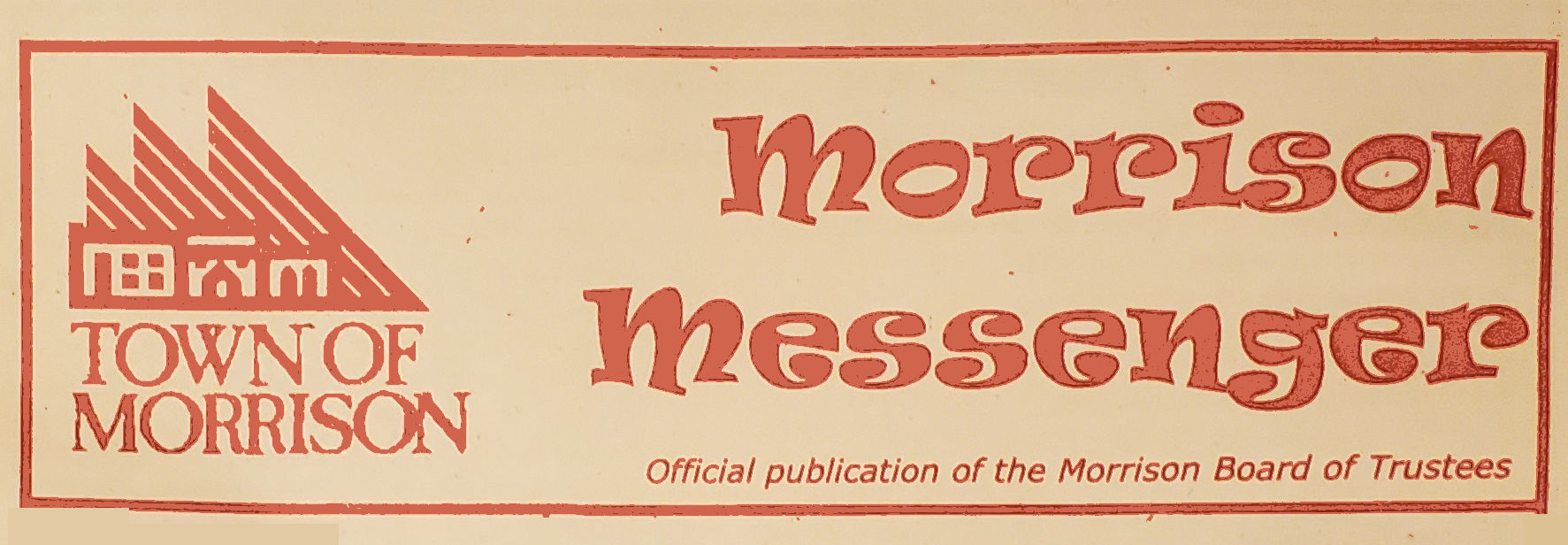
From the Morrison Messenger, Vol. 2, No. 2, March 2001 “Official publication of the Morrison Board of Trustees”
On March 6th, Leo Bradley presented to the Town Board his plans to demolish the stone building at 209 Bear Creek Avenue, historically the Ross Hardware building. The building is to be rebuilt of the same stones and to the same floor plan, updating it to modern construction standards.
The first phase of the Bear Creek Trail into Morrison was underway, as a segment from C-470 to Soda Lakes Road was completed, with the link to Mt. Vernon St. by the end of the month.
The town office solicited volunteers for a creek bank restoration effort, harvesting and planting willows Mar 31-Apr 1 along the new Bear Creek Trail from Soda Lakes Road to Mt. Vernon Street.
The new high zone water storage tank and the pipeline to it from the new pump stations were essentially completed.
Finishing touches were being applied to the rehabilitation of the water treatment plant, the first of its kind in Colorado to partially disinfect drinking water using ultra-violet treatment.
From 2000 to 2003, more than 20 issues of the Morrison Messenger were published. Here’s a special issue honoring Rolf Paul, from February 2002.
The Town’s current newsletter is the Morrison Hogback, published in digital form only. Back issues (Sept 2019 to current) are available on the Town website.
We love hearing from readers, and we always learn something new about Morrison’s history! Here are some stories from comments made in recent years. We invite you to add your own comments to any posts that strike your fancy.
Yvonne wrote (in 2022):
I was born (1940) in Evergreen where my family had emigrated in the 1860s and homesteaded. Morrison was part of the Evergreen life and history. My father (b. 1907) talked about skating on Bear Creek all the way to Morrison. A stagecoach served to carry passengers between the two towns. I was told that my grandfather’s ranch was the source of Kosher cattle which he would drive down the Canyon to the railroad where they would be turned over to the Jewish community for Denver. I remember well the stops at the Tabor Bar and the town around it, since it was the “halfway” point in the (then) long drive to Denver.
From Jeannine (in 2022):
James Wilson Haworth along with his wife Alverda Rice and infant daughter Arminta left Springfield Missouri and moved to Morrison in 1875. They sold their drugstore in Springfield and joined a wagon train heading west to Colorado. They set up a drugstore in Morrison and lived there until 1880. Two sons were born to them there. Julius Ross Haworth in 1876 and Samuel Elmer Haworth in 1879. Their little daughter Arminta passed away Nov.3 1875. She is likely buried there in Morrison. In 1880 the family moved on to Pueblo Colorado and set up another drugstore. Their daughter Alma was born there in August 1880. Living very close to the Haworths was Alverda’s widowed Mother Henrietta Lewis Rice, along with her three children. The whole extended family eventually moved farther west with the wagon trains into Oregon and Idaho where family still reside.
From Linda (in 2020):
Willow Ridge Manor, now located in Morrison [on Hwy 8 near The Fort], was originally a private home located on Old Kipling Rd. My grandfather, George Alexander Allen bought that house and renovated in 1915. The house sat north of the land he donated to build the 1st school on Bear Creek, which was originally called the “Montana School”. My grandfather met my grandmother, Myrtle Griffith, when she came to teach there in 1917, and they were wed in 1919. My father, Jack R. Allen, was born in that house in 1924. They sold the property in 1929.
From Rod (in 2019):
My great grandmother was Martha Ann (Bergen) Greene, daughter of Thomas Cunningham Bergen and Judith Roe Fletcher. Her father, who founded what is now “Bergen Park” in 1859, eventually moved down Bear Creek to farm just south of Morrison in the early 1870’s. He was the first to dig a couple of ponds for irrigation and cultivate a fish business there. The two small ponds are yet on the T.E.V. Edelweiss outdoor Facility property. My great grandmother was married there on Hogback Ridge 11 June 1876 to Thomas Henry Greene. They eventually moved back to Hopkinton, RI in 1880 (his birthplace) to care for ailing family.
In 2008 my brother and I travelled to Bergen Park, Idaho Springs, and Morrison tracing the Bergen family sites. With the help of a 1928 photo album of my grandfather’s, who had taken his mother back to Colorado in 1928 to visit with her brother, William Henry Bergen (whom she hadn’t seen in 48 years) and four generations of his family there … my brother and I were able to locate Thomas C Bergen’s headstone in the Old Morrison Cemetery just above the town (and just below The Red Rocks Park).
We also traveled up “Oh My God” Road, off the Virginia Canyon Rd out of Idaho Springs to Central City. It runs up through Gilson Gulch where my great grandmother, Martha Ann Bergen, spent two years running a boarding house for the Gilson’s while my great grandfather Thomas had staked and was mining two claims. Martha’s first child was born up there on Christmas Day 1877. In 1880 they sold their claims and went to Hopkinton, RI, where they raised eight children and were both buried. My great grandmother lived until a week shy of her 100th birthday in 1956.
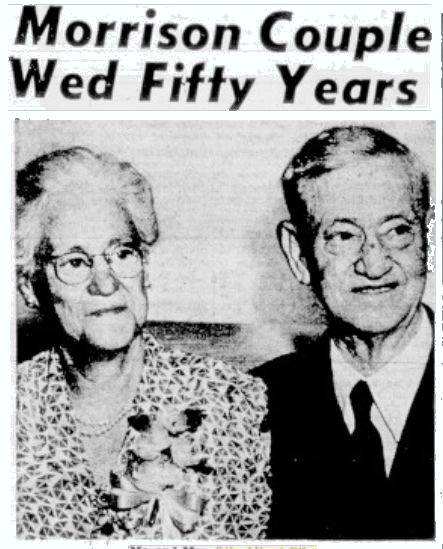
Mollie Dyer moved to Morrison July 3, 1902, when she married Otis Albert Pike. “That’s why we selected her,” Alex Rooney said in 1954 when she was elected Queen of Morrison’s Pioneer Days celebration. “Her husband is Morrison’s oldest surviving pioneer. She’s practically a native herself.” It only took her 52 years!
Born in Missouri Jan. 8, 1883, Mrs. Pike moved to Denver with her parents, Mr. and Mrs. Thomas Jefferson Dyer, in 1889. In 1900 she moved with her father to Cripple Creek, where he started a mercantile business. In Morrison she was active in town life and a community asset with many accomplishments to her credit. Mrs. Pike was a lifelong Democrat, the Rocky Mountain News reported, and served as superintendent of the Morrison Methodist Sunday School. She was also secretary of the school district 12 years and president of the school board four years, a leader in PTA, active in Red Cross and child welfare work, and a leader in salvage and war bond work in two World Wars. In 1954, she was named Queen of Morrison’s Pioneer Days event. For 35 years, she also wrote a column for Jefferson County weekly newspapers.
Mollie Dyer Pike and Otis Albert Pike on the occasion of their 50th wedding anniversary, July 1952.
Mollie’s husband, Otis Albert Pike (1877-1955), was a Morrison native and a grandnephew of Gen. Zebulon Montgomery Pike, for whom Pike’s Peak is named. His parents were Anderson Gage Pike (1830-1899) and Hannah Fenton Pike (1840-1887), pioneers who settled in Morrison sometime after 1864, leaving three children behind in Westview Cemetery in Kirkville, Iowa. Otis served the town as its Mayor for 14 years (circa 1930s) and owned the Pike and Perry Mercantile.
Otis and Mollie had three daughters, Esta Pike Burke (1903-1991) of New York City; Alberta Pike Boyd (1905-1975), owner of Denver’s Vogue Theater; and Genevieve Pike Moore (1907-1974), an employee of the Defense Department in Anchorage, Alaska. The Pikes are buried in the Morrison Cemetery; a nearby stone memorializes their daughters.
The Rocky Mountain News (Daily), Volume 95, Number 210, July 29, 1954; RMN, Volume 93, Number 188, July 6, 1952; RMN, Volume 96, Number 354, December 20, 1955.
Reader Luann commented on the “Deadly Duel” post to let us know about another historic murder in town. She writes:
Another illustrious story for consideration involves the shooting of my grandfather James William Hair by John Anderson at the pool hall in July of 1928. My grandfather was with the Secret Service so his shooting and all that followed was headline news.
Sgt. Leo, of the Morrison Police Dept., researched this one a few years back. Here’s the outline, but you can read his full story here (pdf), as reported in Morrison’s Hogback News, Sept 2018. The story was followed by area newspapers for months after the event.
Operative James Hair was engaged in an outdoor shooting match in downtown Morrison with James and Perry Knoll on July 12, 1928, when the men were approached by John Anderson, a bootlegger from Denver. Anderson was on parole at the time, on a charge of operating a still. He pulled a pistol and shot Hair in the chest, then disappeared into crowds emerging from local businesses. Anderson was captured and sentenced to life in prison. He was later granted a new trial and found guilty of manslaughter, with a one-year sentence. A later trial on the still charge added two years to his sentence. His wife Iris avoided being charged as an accomplice, and divorced him soon after.
Operative Hair was 34 at the time of his death, a University of Colorado graduate and World War I veteran who had joined the U.S. Secret Service two years earlier. He left a wife and two children.
Sgt. Leo was unable to pin down the location of a downtown shooting range, but it sounds as though it had to be near the town’s main intersection at Bear Creek Avenue and Stone St. The local businesses mentioned were Pike & Perry Mercantile (& dance hall) and Peinze’s Grocery Store, which occupied the two corners. Across the street was the large parking lot, formerly the railroad depot, used for various town activities. I’d guess any “outdoor shooting range” close to downtown would have to be in that area. Does anyone have better information? If so, please drop a comment below.
(Morrison pioneer justice, or Ned kills Ed kills Ned, 1879)
Morrison Pioneers to Have Their Say
“The old folks will get the opportunity they’ve been looking for -- a chance to have their say– at Morrison’s unique Pioneer Day celebration, July 30,” reported the Rocky Mountain News, July 17, 1949. Among the highlights of the event:
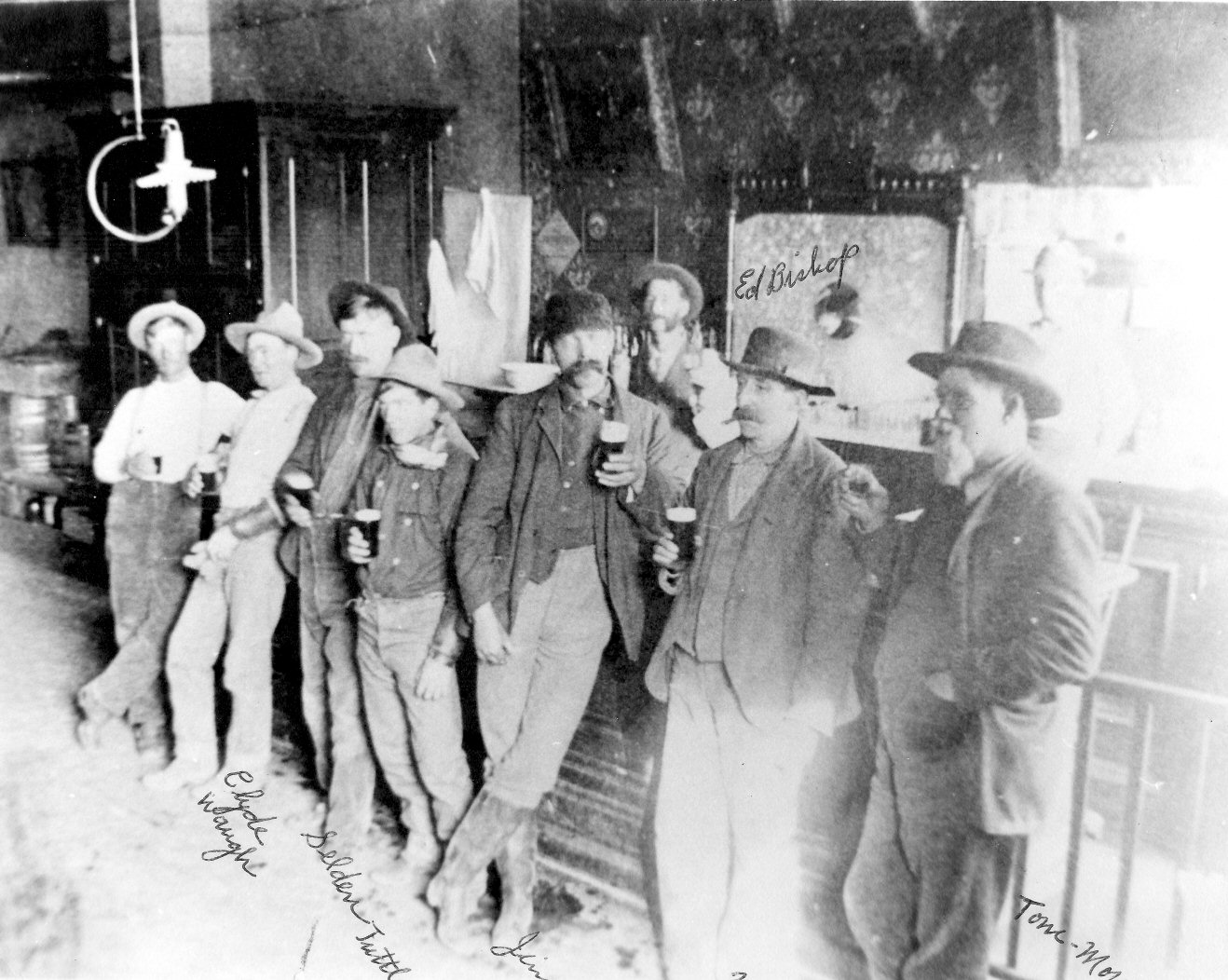
A quiet evening at the Schrock Saloon.
And there will be a dramatic story of the “Deadly Duel Fought in Morrison,” as newspaper headlines proclaimed. The duel took place in 1879 when Ed Sunderland was playing pool in Schrock’s Saloon at Morrison. Ned Pratt entered and started shooting out the lights, an exercise that caused Ed to descend upon him with a billiard cue.
One thing led to another, and Ned shot Ed twice in the forehead. The town marshall happily was close by and rushed in to charge Ned with murder.
But at that moment Ed raised himself on one knee, held his left hand over his wounds, and with his right hand sent a .45 caliber bullet crashing through Ned’s midsection. Ned died instantly, and Ed followed him 15 minutes later.
NOTE that above is a story passed down and written some 60+ years after the event. See comment below for links to “more accurate” accounts from the time, which was apparently 1885. Thanks, Joel…
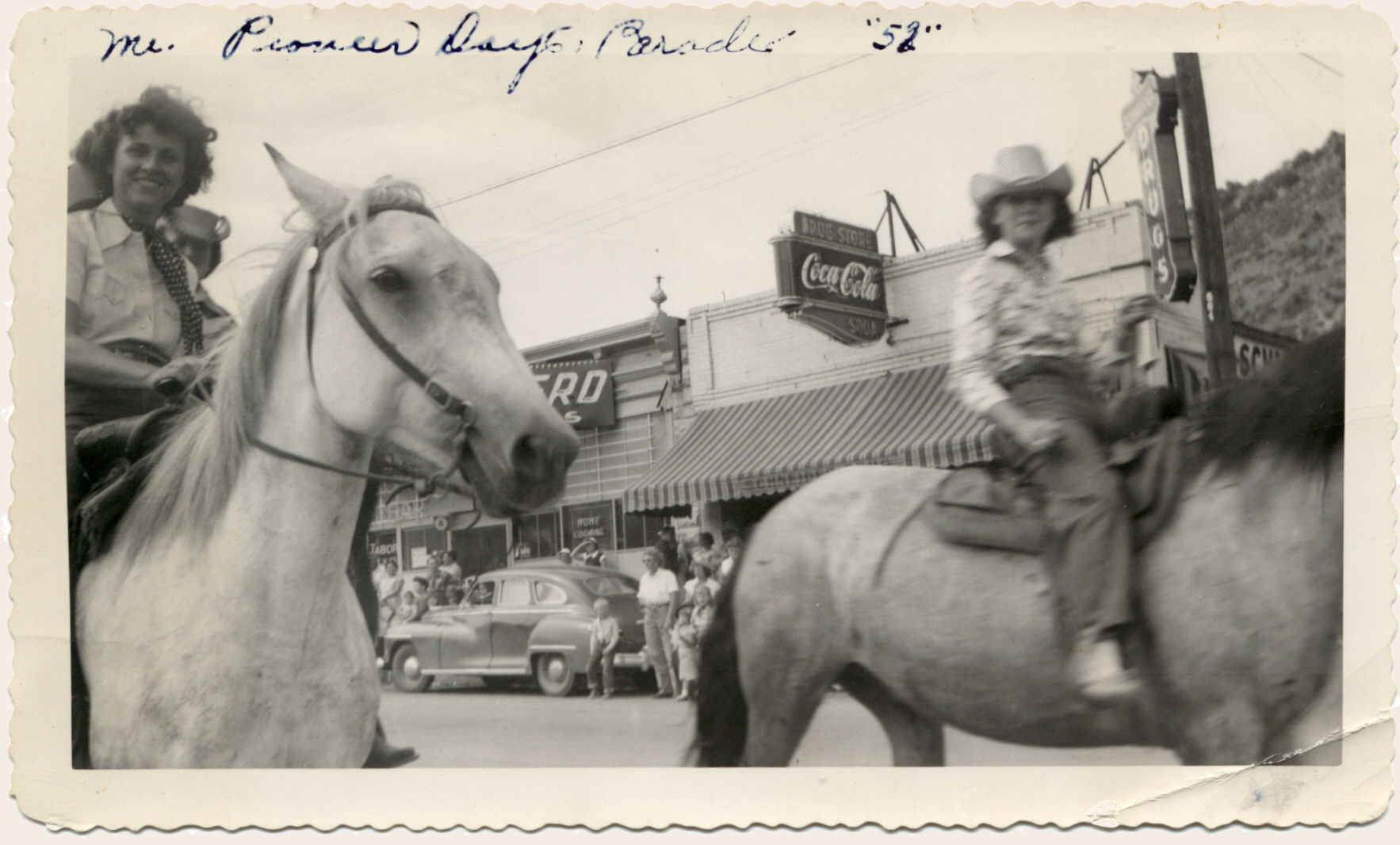
Pioneer Days were celebrated for more than a half-century in Morrison, and the parade down Bear Creek Avenue was especially popular. Stagecoach rides, showdowns, and visits to “jail” were other popular activities during the event.
Two young ladies riding in the Pioneer Days parade, 1952.
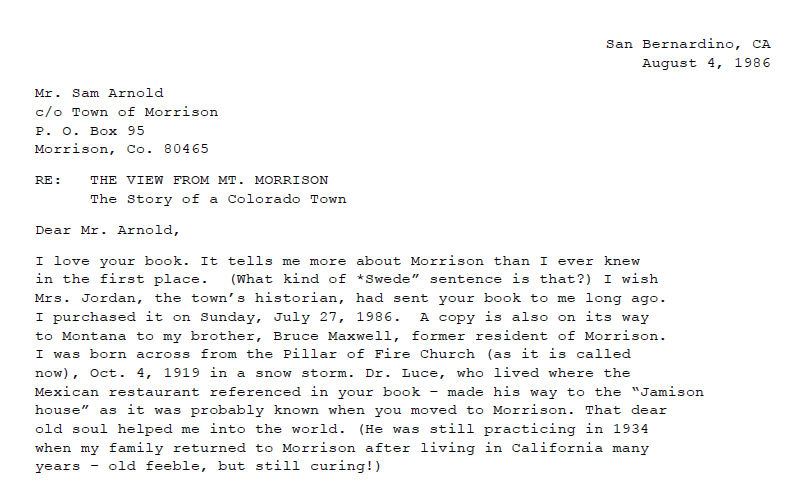
When the Morrison Heritage Museum was in operation, the Town staff directed any historical correspondence to us. In the 1990s, we received several postcards from Bettie Swanson Ries, the granddaughter of John Swanson. But the letter we’re sharing today was written in 1986 to Sam Arnold, and is included in the Morrison Historical Collection at the Jefferson Co. Archives.
The beginning of a letter from Bettie Swanson Ries to Sam Arnold, written August 4, 1986.
Bettie began her letter with a note of appreciation to Sam Arnold for his little book, The View from Mt. Morrison, but went on to share a variety of reminiscences about her time growing up in Morrison, at the Cliff House in the 1930s. People and places remained fresh in her memory when she visited in July 1986, and she writes that “it lifted my heart on Sunday July 27 to see the young people of today enjoying Morrison and environs in their way, and to recall how we enjoyed and loved it in ours 50 years ago.” Bob Dylan had played Red Rocks that weekend.
The Swanson Family, second owners of the Cliff House.
Peggy Hahn invited me into the Cliff House as my grandfather, John Swanson was the second owner. I gave her a lot of information about how it was in 1929, and how I recalled what my mother, Helen Keel Swanson said it was when she came as a bride. My father Harry Swanson never knew any other way of life except hotel living.
From Red Rocks to Soda Lakes and Berriens to Schneiders, Bettie packed a lot of stories into this one letter. Working at the Hillcrest Inn, swimming in the pool there, and climbing Red Rocks— times were different in Morrison back then. Read Bettie’s entire letter here.
The Morrison Cowboy Celebration, so the story goes, was conceived early in 1996 when “uncle” Mel Justice was sitting around with a group of locals and sporting a mighty fine, rainbow-colored pair of suspenders. Bob Dougherty was on hand that night when a discussion about Mel’s suspenders led to his mention of a poem called “Billy Carpenter and Smith’s Elastic Braces.” Uncle Mel had never heard it. Bob recited it to Mel and all present, and the idea of a poetry gathering was born.
This inaugural event benefited from the talents of Mary Jordan, who convened a photo shoot at Teresa’s Holiday Bar (that archetypal Morrison saloon) that gave the event a lasting visual imprint. Performers, “saloon girls,” and one unnamed equine launched an image that rocked Morrison for five years running. Debby Mason and Roger Poe signed on as organizers; Patrick Gerace designed a logo and program artwork; and town businesses got involved as sponsors and advertisers. It was a community effort.
1996 performers gathered at Teresa’s Holiday Bar; Jerry Walker, Roz Brown, Bob Dougherty, Liz Masterson, Sean Blackburn. Also saloon girls with bar owner Kim Bianchi, cowboy Gary Gray, bartender Willie. Photo by Mary Jordan.
The Celebration was a major hit, even that first year! Bob rounded up a few of his friends and put together a show, held at the Morrison Town Hall in early September. Bob Dougherty himself acted as emcee, and other performers included Bill Barwick, Roz Brown, Liz Masterson & Sean Blackburn, Maggie Mae Sharp, and Jerry Walker. You can sample the flavor of the event in these videos by reader Donna DiGiacinto:
My Prairie Home, by Liz Masterson and Sean Blackburn, with stagecoach scenes in Morrison
According to a later report (we’re pulling from the old website here):
Maybe we should start with what the Morrison Cowboy Celebration is NOT. It isn’t a weekend-long festival of all things cowboy. No pony rides, no chuckwagon cookouts. No rodeo. At least, not yet. You won’t find a whole lot of fringe and glitter, but lots of worn jeans and working cowboy hats. It is two grand evenings of some of the best and most diverse cowboy music and poetry you’ll find under one roof at one time. Two evening performances offering a great value for your entertainment dollar. (Because of the small size of the Morrison Town Hall, advance tickets are strongly recommended.)
Australian-born emcee Bob Dougherty entertained audiences with classic cowboy poetry and loud shirts at the Morrison Cowboy Celebration. Photo by Mary Jordan.
As Morrison’s resident (via Australia) cowboy poet, Bob became the emcee and focal point, known as well for his loud cowboy shirts as for his Down-Under-inflected poetry. Bob was once profiled in Westword, whence this introduction:
In the evening, Bob Dougherty works behind the bar at Theresa’s Holiday Bar in Morrison. Dressed all in black, his long gray hair pulled back severely from his face, a cigar clamped between his teeth, he will look up from the taps and say something terse and Western, such as: “Hello, trouble.” He will say this with an Australian accent.
Dougherty is a mass of details: tattoos, earrings, the Three Tenors on CD, an ability to converse in Thai, wine snob, baseball fanatic, extra in the film The Man From Snowy River—”my derriere, anyway”—and, sentimental fool that he is, a tendency to shower women with red roses and Swiss chocolate. —from The Odd Couplet BY ROBIN CHOTZINOFF, Westword, May 23, 1996
At the end of the two evenings, performers launched a tradition for the event by gathering onstage for a rendition of “Happy Trails” to send their audience home on a high note.
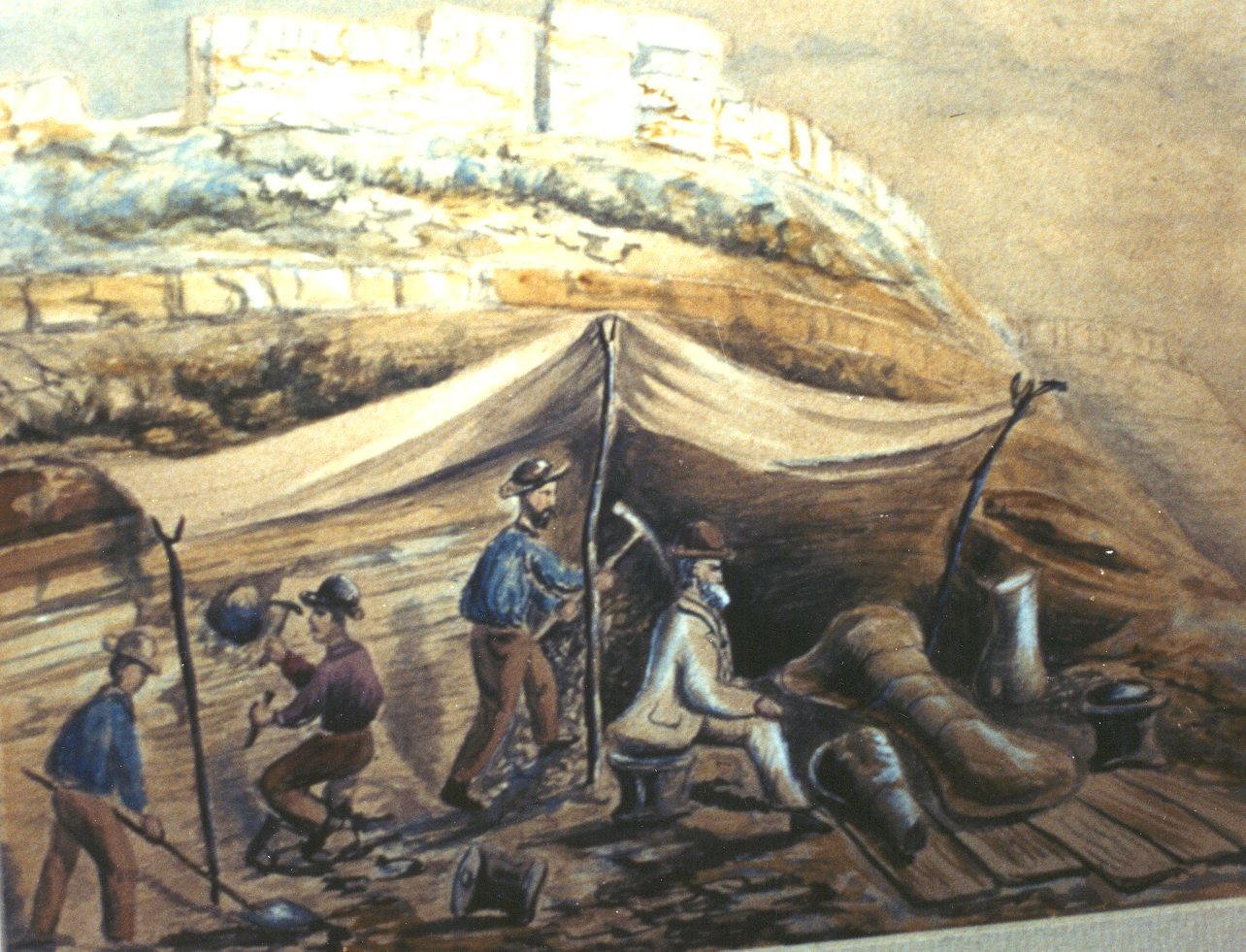
Quarry #10 near Morrison, or Clay Saurian #1, as drawn by Rev. Arthur Lakes.
One hundred forty years ago this month, Morrison entered the history of paleontology in an impressive way, with the discoveries made by Rev. Arthur Lakes on the hogback north of our small town.
On a Tuesday in late March 1877, a young professor made a discovery at what is now Dinosaur Ridge, near Morrison in Jefferson County, Colorado. This discovery transformed American geology and started a revolution in our understanding of dinosaurs. It also sparked a dinosaur “gold rush” that led the great scientific institutions of the East to turn their sights west. The fabulous wealth of such men as George Peabody, Andrew Carnegie, and Marshall Field was unleashed in a quest for the biggest and most bizarre dinosaurs to fill their museums. —Hunt, Lockley, & White, 2002
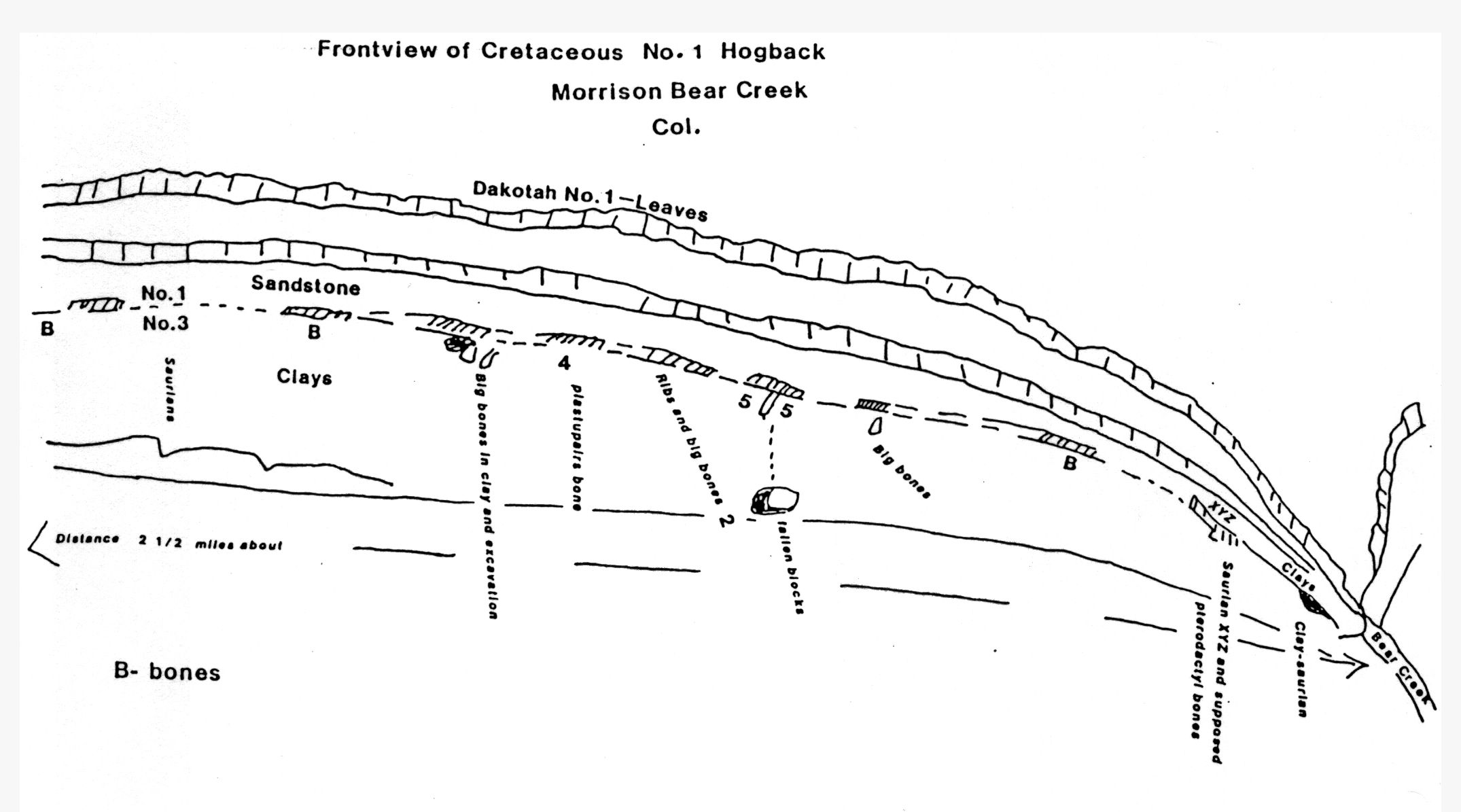
Arthur Lakes sketch of the quarries along the west slope of the Dakota hogback, from a letter to in 1879.
Ultimately, Lakes agreed to send the dinosaur bones discovered at Morrison to Professor O.C. Marsh at Yale’s Peabody Museum. For the next two years, Lakes and colleagues (including Benjamin Mudge, in white in above drawing) continued to send bones and reports to Marsh documenting their work at 14 sites along the hogback. Lakes also recorded their activities in his diaries, leaving us an extensive historical record of Morrison’s part in the “Bone Wars” of the late 19th century.
Lakes sent his first letter to Marsh on April 2nd, 1877. This letter told Marsh about the discoveries and their position in the sequence of rocks. He included good drawings of two partial bones and a detailed sketch of the geology of the area now known as Red Rocks Park and Dinosaur Ridge. —Hunt, Lockley, & White, 2002
Only four of the quarries yielded significant discoveries. Quarry #10, the Clay Saurian, is known for Apatosaurus ajax (YPM 1860). This site near the southern end of Dinosaur Ridge was relocated in 2002 and has been worked since then by teams from the Morrison Natural History Museum. Based on Lakes’s sketches of the hogback, his diaries, old photos, and field surveys, the location of Quarry #1 was identified in September of 2009 (Ghist & Simmons, 2010). The rediscovered quarry site was named a county landmark in 2014. This and other sites along Alameda Parkway are managed and interpreted by the Friends of Dinosaur Ridge.
National Natural Landmark Plaque on Dinosaur Ridge
The entire “Morrison Fossil Area” was named a National Natural Landmark in 1973. In 2011, the Landmark was expanded to include Late Cretaceous track sites near Golden, and is now called the “Morrison-Golden Fossil Area.”
Hunt, Adrian, Lockley, Martin and White, Sally. 2002. Historic Dinosaur Quarries of the Dinosaur Ridge Area Friends of Dinosaur Ridge and the University of Colorado at Denver Trackers Research Group.
More information on Morrison history is available at Jeffco Archives. Contact Archivist Ronda Frazier (rfrazier@jeffco.us) for access to the Morrison History Collection.








 Morrison History
