“Where is Peter Fischer’s Rock?” asked an interested descendant early in my tenure as a Morrison historian of sorts, maybe about 1996. Answering questions was a key part of the job, but this one had me stumped. I’d never even heard of Peter Fischer, though I’m confident Morrison’s earlier historian, Lorene Horton, probably had. His early arrival and many contributions to the area qualify him for “pioneer” status. Why did he seem so little known, hardly remembered?
Peter’s story as adapted and abbreviated from a summary by his great-great-granddaughter Melanie Holmberg:
Peter Fischer, Morrison pioneer
Peter Fischer was born in Germany in 1826 and immigrated to Illinois in 1849 with his family (including parents, brothers, and sister). At age 33, he left the family farm in Illinois (and his wife Catherine) and moved alone to Cherry Creek in the spring of 1859, where he established a nursery business on the shores of Cherry Creek. Catherine joined him in 1860. In 1872 (before the railroad line to Morrison was completed), Peter, Catherine and 6-year-old Clara Fischer moved to Morrison, perhaps because he’d heard about the coming railroad.
After Peter moved to Morrison he “engaged in improving his farm and experimenting on fish and is now in possession of a beautiful beer garden.”1 “Laurelei [also Lorelei] Park, near the mouth of the canon, is the favorite resort of the people of Morrison, and the surrounding country. Its proprietor, Mr. Peter Fischer, has spared neither pains or expense in fitting up a nice place for a summer resort, and seems to be reaping a rich reward for his enterprise.”2
Fischer’s Flume, constructed across Peter Fischer’s Rock “above” Morrison.
Peter may have owned land on “Fischer’s Mountain,” aka Mt. Fischer, now Mt. Falcon. He was also the owner of Fischer’s Ditch and Flume. “Fischer’s Rock,” or “Peter’s Rock,” is the large red sandstone outcrop overlooking Morrison on which he built Fischer’s Flume “to carry water around Mt Glennon to Turkey Creek.”3 He constructed two ponds, one to serve as a swimming pool and bathing area (for which he charged admission) and a lower one to water his livestock and farm (perhaps also for the above-referenced fishery).
After his daughter’s move to Denver and his second wife’s death, Peter suffered multiple financial setbacks and failures. He eventually left Morrison for Denver, impoverished, and was living in a “county home.” He apparently didn’t have a close (or any) relationship with his daughter and grandchildren. At his death, in 1900, he was reported to have dementia.
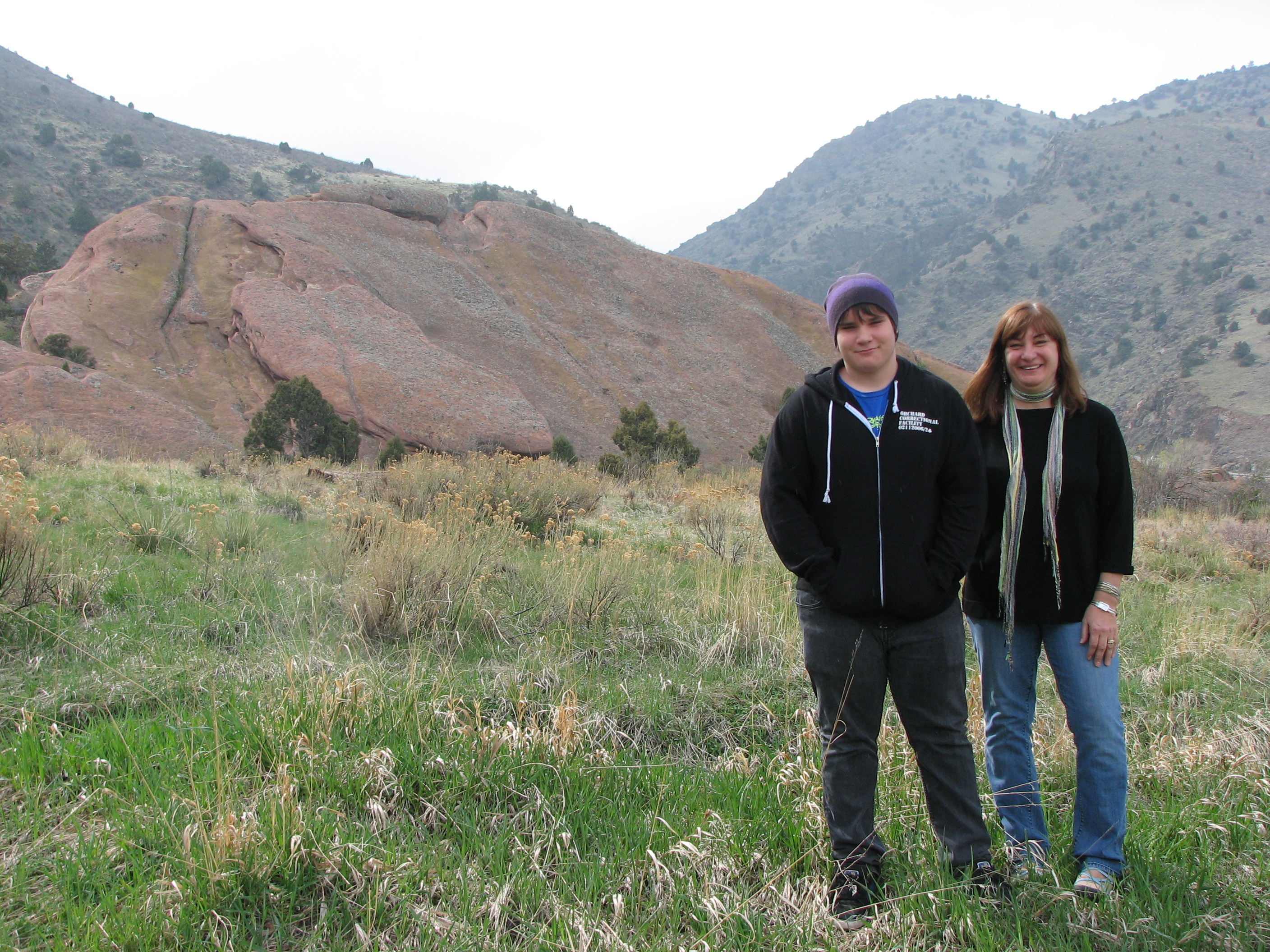
Melanie Holmbergwith son Tim, descendants of the Fischers, on a visit to Fischer’s Rock in 2010.
The story of the Fischer family is, of course, far more complex than this overview. Although Clara was the Fischers’ only surviving child, her marriage to Sabatino Tovani (another story) resulted in six children and an array of descendants.
The flume was short-lived and was therefore sometimes known as “Fischer’s Folly.” Evidence of its presence remains in faint traces on the landscape (see photo below).
Sources:
1 “Morrison Matters: A Word or Two About This Enterprising Foot-Hill Hamlet. Her Business, Agricultural and Grazing Facilities Commented On.” The Rocky Mountain News (Daily), Volume 25, April 27, 1884.
2 “Lively Morrison: A Rough Sunday’s Work—A Man Kicked to Death on Sunday—Notes of Business Progress and Social Gossip.” The Colorado Transcript, July 20, 1881
3 Kowald, Francis. “A Brief Historical Sketch and Some Reminiscences of The Sacred Heart College,” typed manuscript, circa 1935, housed in Archives and Special Collections, Regis University.
Aerial photo of Morrison area labeled showing approximate location of Fischer’s Flume.
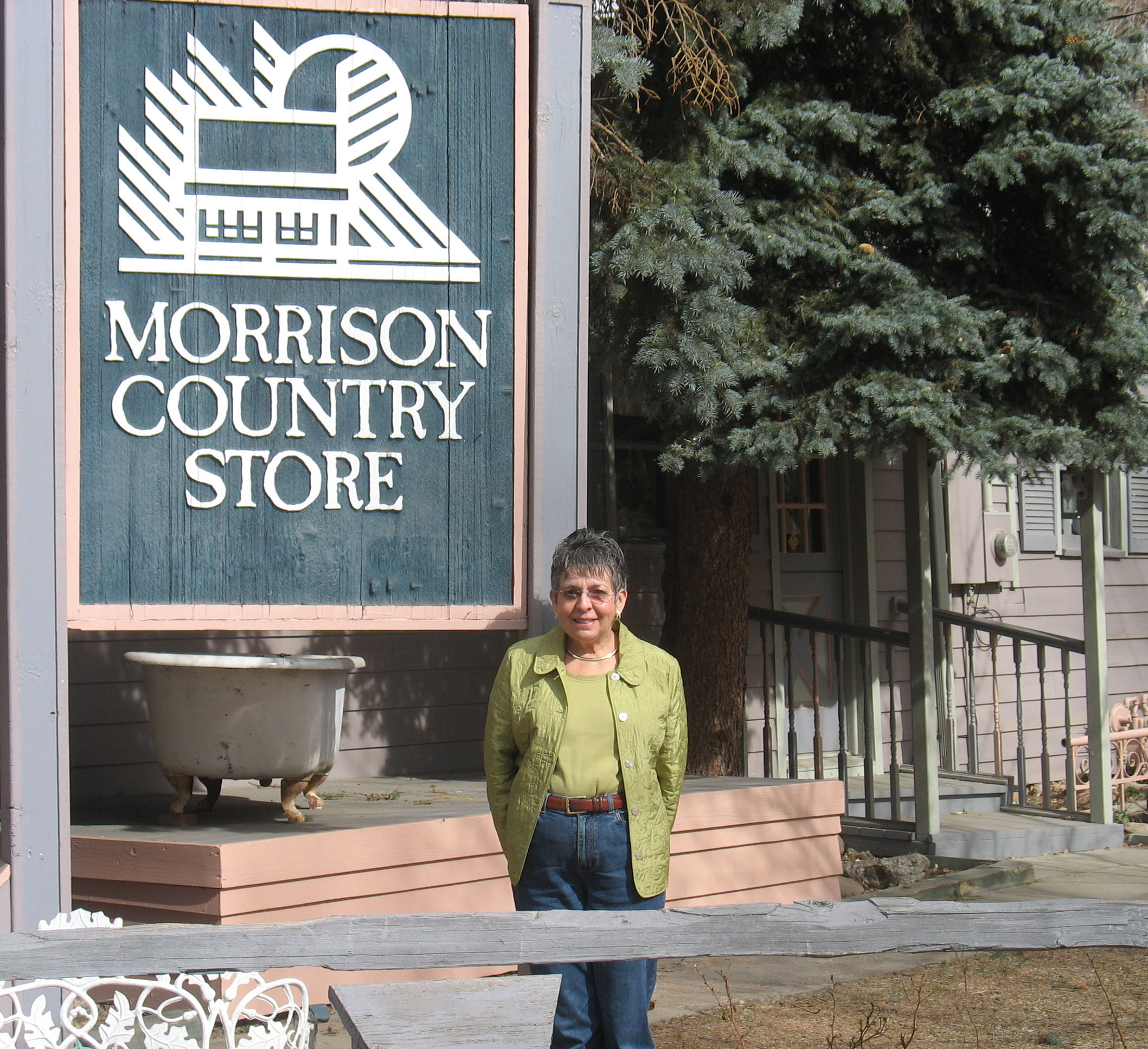
Ginny Paul standing next to the Morrison Country Store sign in 2009, with graphic logo designed by Rolf Paul.
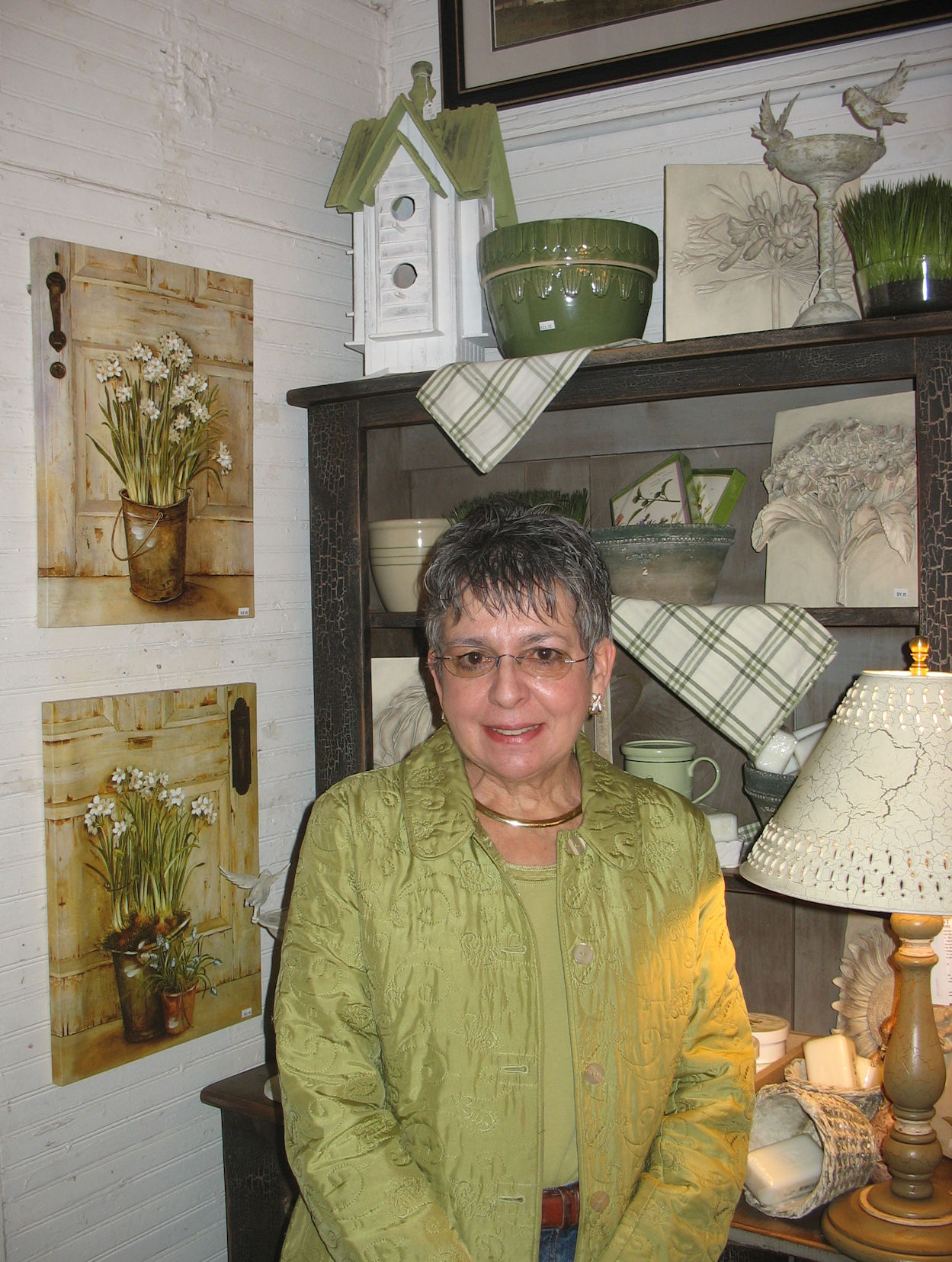
Virginia Paul and her husband Rolf came to Morrison in 1969, where he set up a small printing business in their home. In 1984, she launched her own small business, the Morrison Country Store,* which would become one of the town’s lasting enterprises, drawing customers from across the metro area and beyond. I visited Ginny and documented her charming shop in these photographs in 2009.
Where Rolf was, Ginny writes, “an activist & a mover & a shaker” who served on the Town Board and even as Mayor for a time, she preferred to “stay out of all the controversy… and just be a good citizen.” And a very successful businesswoman, as evidenced by the longevity of the Morrison Country Store, a gift and décor oriented shop with a loyal clientele much like that once drawn by Thee Deacon’s Bench and the town’s many antique stores. The shop was closed in 2018, just two years before Ginny’s death in 2020.
Ginny at the Morrison Country Store in 2009. One of the plaques above her has a Helen Keller quote: “Your success and happiness lie in you.”
Despite Ginny’s reticence, she did end up serving on the Town Board for several years after Rolf’s death, where she was “an advocate and voice for local businesses.”
Ginny Paul standing with some of the displays at the Country Store.
Rolf and Ginny supported cultural events and organizations in Morrison and beyond, including the Jefferson Symphony and the Morrison Natural History Museum.
Ginny considered the museum “a great addition to the Town” and a “gift of culture to the metropolitan area.”
Ginny Paul and her Morrison Country Store are well remembered by Morrison residents and long-time visitors. Today the Morrison Mercantile carries on some of Ginny’s legacy, in another form.
Quotes above are from Ginny’s letter to the Town Board in February 2002, shortly after Rolf’s death, when she was drawn into ‘controversy and turmoil’ and spoke her mind in response to an edition of Lew’s News.
Remembering Virginia (Ginny) Paul (Morrison Hogback newsletter, October 2020)
We would like to remember the life of long-time resident, Ginny Paul. She was the definition of “Keep Morrison, Morrison” from her care and dedication to the Town, to her radiating entrepreneurial spirit and fruitful local business, Morrison Country Store. Ginny served her community well. She selfishly [sic] volunteered her time to the Planning Commission and Board of Trustees throughout her years. During Ginny’s time on the Board and Planning Commission, she was an advocate and voice for local businesses, an integral part in the Rooney Valley Development discussions and Town Comprehensive Plan update in 2008. Her insight as a resident and business owner allowed for a unique perspective that was appreciated and valued in the Boards’ policy making. Ginny will be greatly missed, and we send our sympathy to her friends and family. Morrison will not be the same without her.
* Actually, even before Ginny began her business, the location was known as the Morrison Country Store, run for many years by Tom and Bonnie Hicks, who specialized in antiques and collectibles.
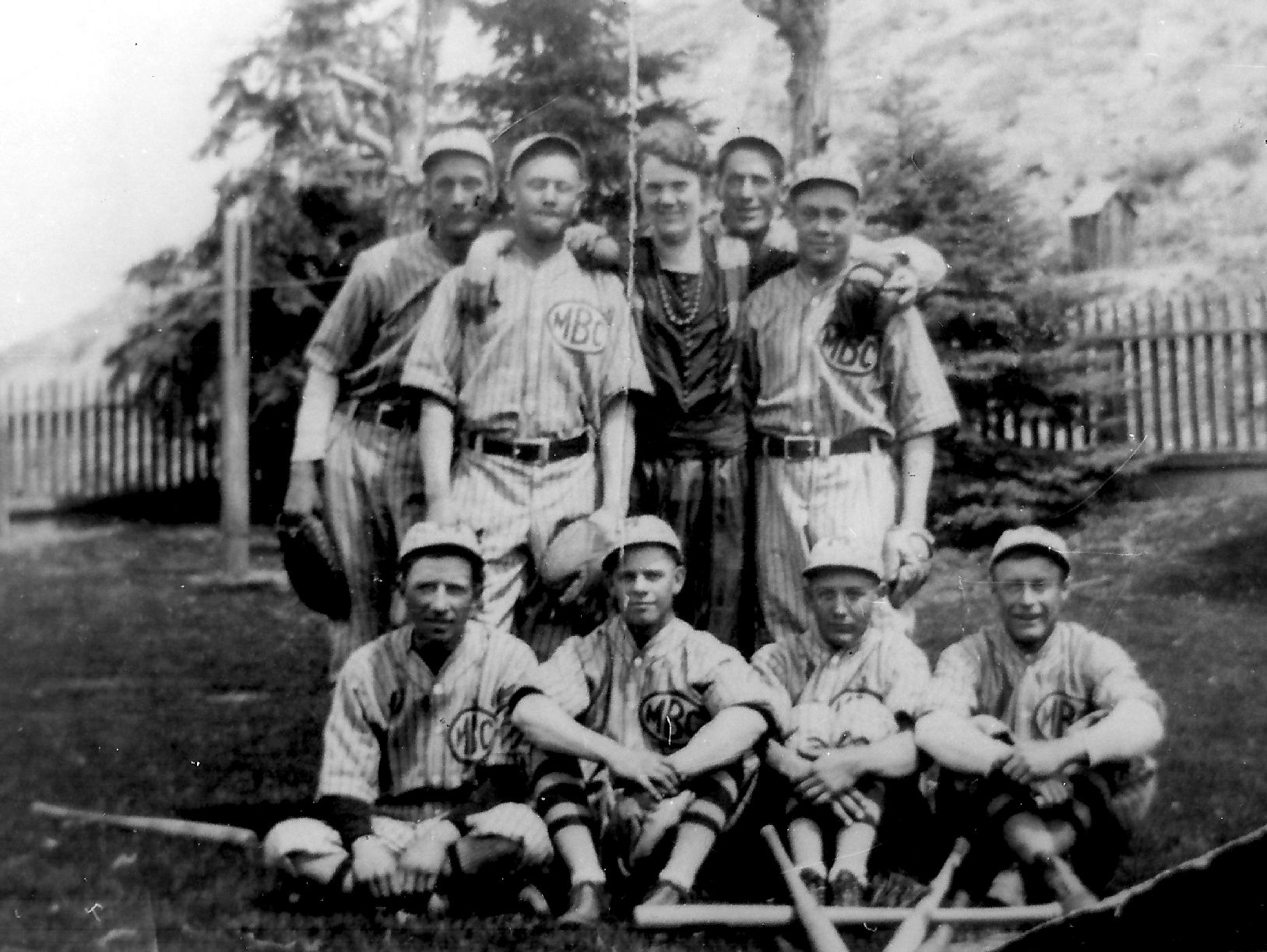
The Morrison baseball team, about 1915. Front row: Lawrence Knolls, Dan Schneider, Ted Schrock, Billie Sawyer. Standing: Henry Recks(?), Joe Schrock, Mrs. Kirby, Jim Groom, Tom Fleming.
Morrison fielded baseball teams regularly in the last century. The ballfield was east of town, where the wastewater management plant now stands. “Mrs. Kirby,” Lizzie C. Kirby (aka “Babe”), lived on Spring St. and served in Red Rock Circle No. 130 of the Women of Woodcraft in 1906 (Jeffco Graphic, 2/16/1906) and as a lecturer in the Bear Creek Valley Grange in 1912 (Arvada Sun, 1/19/1912).
Morrison Baseball Timeline
May 1902: Morrison Baseball Club (MBC) defeated Littleton 12 to 13(?). “The game was well played, close, and exciting.” Battery for Morrison included Nay, Evans, and Johnson; Littleton: Norton, Smith, and Bell. (RMN, 5/31/1902)
1908: “The Morrison Greys are showing fine form this year in scoring a 12 to 9 victory over the Twenty-first infantry team in a game at Morrison.” Howell and Boyd formed the winning battery. (RMN, 4/29/1908)
March 1910: “Morrison Reds will play any amateur team Sunday for expenses”; telephone D. Durham. (RMN, 3/26/1910)
May 1910: Morrison team defeats Manchester Athletic club, 12 to 6. (5/30/1910)
June 1910: Morrison wants a game for next Sunday. (RMN, 6/17/1910)
May 1927: Mt Morrison organizes a team; holds a dance to raise money for the “suits”
June 1927: “Morrison will entertain the Mines & Smelter team of Denver” Sunday. (RMN, 6/5/1927)
August 1930: Guy Hill team will play Morrison nine on Labor Day (Jeffco Rep, 8/28/1930)
Sept 1930, Golden Reds played Morrison in RR Park; Morrison won 8 to 4. (Jeffco Rep, 9/11/1930)
We love hearing from readers, and we always learn something new about Morrison’s history! Here are some stories from comments made in recent years. We invite you to add your own comments to any posts that strike your fancy.
Yvonne wrote (in 2022):
I was born (1940) in Evergreen where my family had emigrated in the 1860s and homesteaded. Morrison was part of the Evergreen life and history. My father (b. 1907) talked about skating on Bear Creek all the way to Morrison. A stagecoach served to carry passengers between the two towns. I was told that my grandfather’s ranch was the source of Kosher cattle which he would drive down the Canyon to the railroad where they would be turned over to the Jewish community for Denver. I remember well the stops at the Tabor Bar and the town around it, since it was the “halfway” point in the (then) long drive to Denver.
From Jeannine (in 2022):
James Wilson Haworth along with his wife Alverda Rice and infant daughter Arminta left Springfield Missouri and moved to Morrison in 1875. They sold their drugstore in Springfield and joined a wagon train heading west to Colorado. They set up a drugstore in Morrison and lived there until 1880. Two sons were born to them there. Julius Ross Haworth in 1876 and Samuel Elmer Haworth in 1879. Their little daughter Arminta passed away Nov.3 1875. She is likely buried there in Morrison. In 1880 the family moved on to Pueblo Colorado and set up another drugstore. Their daughter Alma was born there in August 1880. Living very close to the Haworths was Alverda’s widowed Mother Henrietta Lewis Rice, along with her three children. The whole extended family eventually moved farther west with the wagon trains into Oregon and Idaho where family still reside.
From Linda (in 2020):
Willow Ridge Manor, now located in Morrison [on Hwy 8 near The Fort], was originally a private home located on Old Kipling Rd. My grandfather, George Alexander Allen bought that house and renovated in 1915. The house sat north of the land he donated to build the 1st school on Bear Creek, which was originally called the “Montana School”. My grandfather met my grandmother, Myrtle Griffith, when she came to teach there in 1917, and they were wed in 1919. My father, Jack R. Allen, was born in that house in 1924. They sold the property in 1929.
From Rod (in 2019):
My great grandmother was Martha Ann (Bergen) Greene, daughter of Thomas Cunningham Bergen and Judith Roe Fletcher. Her father, who founded what is now “Bergen Park” in 1859, eventually moved down Bear Creek to farm just south of Morrison in the early 1870’s. He was the first to dig a couple of ponds for irrigation and cultivate a fish business there. The two small ponds are yet on the T.E.V. Edelweiss outdoor Facility property. My great grandmother was married there on Hogback Ridge 11 June 1876 to Thomas Henry Greene. They eventually moved back to Hopkinton, RI in 1880 (his birthplace) to care for ailing family.
In 2008 my brother and I travelled to Bergen Park, Idaho Springs, and Morrison tracing the Bergen family sites. With the help of a 1928 photo album of my grandfather’s, who had taken his mother back to Colorado in 1928 to visit with her brother, William Henry Bergen (whom she hadn’t seen in 48 years) and four generations of his family there … my brother and I were able to locate Thomas C Bergen’s headstone in the Old Morrison Cemetery just above the town (and just below The Red Rocks Park).
We also traveled up “Oh My God” Road, off the Virginia Canyon Rd out of Idaho Springs to Central City. It runs up through Gilson Gulch where my great grandmother, Martha Ann Bergen, spent two years running a boarding house for the Gilson’s while my great grandfather Thomas had staked and was mining two claims. Martha’s first child was born up there on Christmas Day 1877. In 1880 they sold their claims and went to Hopkinton, RI, where they raised eight children and were both buried. My great grandmother lived until a week shy of her 100th birthday in 1956.
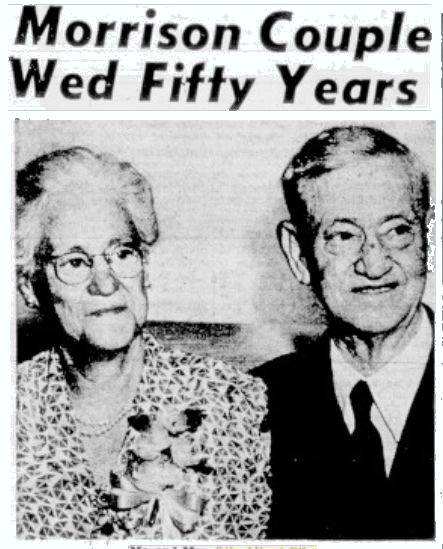
Mollie Dyer moved to Morrison July 3, 1902, when she married Otis Albert Pike. “That’s why we selected her,” Alex Rooney said in 1954 when she was elected Queen of Morrison’s Pioneer Days celebration. “Her husband is Morrison’s oldest surviving pioneer. She’s practically a native herself.” It only took her 52 years!
Born in Missouri Jan. 8, 1883, Mrs. Pike moved to Denver with her parents, Mr. and Mrs. Thomas Jefferson Dyer, in 1889. In 1900 she moved with her father to Cripple Creek, where he started a mercantile business. In Morrison she was active in town life and a community asset with many accomplishments to her credit. Mrs. Pike was a lifelong Democrat, the Rocky Mountain News reported, and served as superintendent of the Morrison Methodist Sunday School. She was also secretary of the school district 12 years and president of the school board four years, a leader in PTA, active in Red Cross and child welfare work, and a leader in salvage and war bond work in two World Wars. In 1954, she was named Queen of Morrison’s Pioneer Days event. For 35 years, she also wrote a column for Jefferson County weekly newspapers.
Mollie Dyer Pike and Otis Albert Pike on the occasion of their 50th wedding anniversary, July 1952.
Mollie’s husband, Otis Albert Pike (1877-1955), was a Morrison native and a grandnephew of Gen. Zebulon Montgomery Pike, for whom Pike’s Peak is named. His parents were Anderson Gage Pike (1830-1899) and Hannah Fenton Pike (1840-1887), pioneers who settled in Morrison sometime after 1864, leaving three children behind in Westview Cemetery in Kirkville, Iowa. Otis served the town as its Mayor for 14 years (circa 1930s) and owned the Pike and Perry Mercantile.
Otis and Mollie had three daughters, Esta Pike Burke (1903-1991) of New York City; Alberta Pike Boyd (1905-1975), owner of Denver’s Vogue Theater; and Genevieve Pike Moore (1907-1974), an employee of the Defense Department in Anchorage, Alaska. The Pikes are buried in the Morrison Cemetery; a nearby stone memorializes their daughters.
The Rocky Mountain News (Daily), Volume 95, Number 210, July 29, 1954; RMN, Volume 93, Number 188, July 6, 1952; RMN, Volume 96, Number 354, December 20, 1955.
Another tidbit retrieved from an earlier version of this website.
No more than an introduction to this historic local family can be attempted in this small space, but the Quaintances deserve a significant place in Morrison’s history, as they have in Golden, where Brough Quaintance had established himself even before Adolph Coors arrived. His family built the Castle Rock Scenic Railway up the west side of South Table Mtn., an enterprise that was later doomed by the arrival of the automobile, and the building of a road, the Lariat Trail, up nearby Lookout Mountain.
Mary Ross Quaintance, for whom our small downtown park(1) is named, was 14 years old and attending the old Morrison schoolhouse the day school was recessed to allow townsfolk to hear soprano Mary Garden sing at Red Rocks. That was in 1911, long before Denver acquired land for the park from her father, John Ross, in 1927 or built an amphitheatre there (1936-1941). Mary remembered visionary John Brisben Walker, who sometimes came to the Ross home for dinner, and she was home from school, sick, the day Walker’s castle on Mt. Falcon burned.(2) Mary Ross married a son of Brough Quaintance, Arthur D. Quaintance, an attorney in Golden and Denver, in 1919. Mary Ross Quaintance died in 1980(3), but is well remembered for her remarkable knowledge of the history of our area.
John Ross, Mary’s father, was one of Morrison’s early businessmen. The stone building next to our new park was his hardware store back in the 1900s, and the family lived in the house at 106 Stone St. that is now occupied by Professional Meetings, Inc.
Reprinted from The Town Crier #4, July 1999 Published by the Morrison Action Committee
(1) Quaintance Park was a small, short-lived “pocket park,” built by townspeople from an unused partial lot tucked between the Ross Hardware building (#11) and the Tom Lewis Home (#10).
(2) These stories are reported by Georgina Brown, who interviewed Mary for her book Shining Mountains, published in 1976.
(3) Mary Ross Quaintance dies at 82 (Canyon Courier Feb 13, 1980) Mrs. Mary Ross Quaintance, whose family has owned Tiny Town for approximately half a century, died at her home in Golden on Friday, Feb. 1, She was 82. Mrs. Quaintance, the widow of Arthur O. Quaintance who died in November, 1959, was born Aug. 8, 1897 in Morrison, the daughter of longtime Morrison residents, John and Mary Ross. Survivors include two daughters, Mrs. Maryanna Q. Johnson of Lakewood and Mrs. Leo (Patricia) Q. Bradley of Golden; four grandchildren and one greatgrandson.
Ruth Matthews Schneider poses in front of a mural honoring area men who served in World War II. The men represent families from Morrison proper (Denbow, Fleming, Hocking), as well as outlying areas from Conifer (Turkey Creek, including LeGault, Granzella, Snedeker) to Lakewood, east along Bear Creek (McCoy, VanGorden). The local VFW Post is named after Paul Westover, who was the first local boy to be killed. He died in the Battle of the Bulge, 1944-45.
This mural was on the east wall of the building at 301 Bear Creek Avenue, now the Morrison Inn, facing Stone St. for many years. Click to enlarge the photo. In May 1984, it was replaced with a stylized Mexican motif of saguaro cacti and exotic birds and flowers, which remains today. Pattie Penegor and Donna Dragos were credited with the design and execution of the new mural.
It seems fitting that we report here, regretfully, the passing of long-time resident Boyd Jacobson. Known by most everyone as Jake, he succumbed to cancer December 29, 1998, in Williston, North Dakota, near his original home of Bonetrail.
He and Clara, his wife of 50+ years, were involved and concerned about matters of our town of Morrison ever since they arrived in 1952. Together they raised 3 sons and 2 daughters at their humble abode on Bear Creek Lane. In the early days, that home even served as the Town Office for many years while Clara was Town Clerk. Their children all still live in the metro area, including Wayne who remains here in Morrison.
During simpler times, Jake was known as the Great Gildersleeve of Morrison, “Water Commish,” working almost single-handedly to keep our archaic water system afloat. When natural gas was introduced here, Jake was very much a part of the implementation. And, as a sheet metal guy, he gladly helped many of our citizens install their very first gas furnaces. Helping others with little more than a “thank you” was his happiness.
Veterans of Foreign Wars, Post 3471 of Morrison, was and still is a viable community service organization, thanks to the hard work and leadership of Jake and his family. He held all the officers’ chairs in his rise to the ultimate rank as Department Commander in Colorado. His son Terry carries on this tradition of active service to our local post.
Jake never had an enemy. His philosophy in life was simple: to be happy no matter the adversity, and to deliver happiness to everyone around him. We will miss his holiday lefsa, lutefisk, and his hearty laughter.
Jake was buried beside Clara on Wednesday, January 6, 1999, at the Morrison Cemetery in Red Rocks. Uff da!
Reprinted from The Town Crier, Jan/Feb, 1999, published by the Morrison Action Committee
It was a thrill recently to meet a former resident of Morrison who had moved away in 1969. He was just a guy who was looking for a residence to buy, or property on which to build. (Of course, we meet people every day with a similar design.) It was only after lengthy conversation, finding that he knew every one of our Morrison forefathers, that we realized he had been here before. He had grown up in the LaGrow house on Bear Creek Lane. He was a LaGrow, his name is Ed Drab, and he’s the son of Morrison’s hairdresser, Ed Drab Sr., who ran a shop on Bear Creek Ave. in the 1960s-70s [in the former bank building where Guiseppe’s is now located; later Mill St. Deli].
After finding out about his family tree, I showed him the “Memory Album, Morrison, Colorado,” by Lorene Horton, published in 1976. Flipping through the pages, he remembered many of the original photos and commented frequently: “that’s my aunt Bertha,” or “there’s Alex (Jordan),” or “there’s my mom when she was a child,” and “there’s Frank Baker.” And so it went, for hours!
He presently resides in Las Vegas, Nevada. His personal knowledge and growing up stories of people, places and experiences were exceedingly valuable. With time, our connections with the important past are thinning.
Footnote: Museums Coordinator Sally White adds that we have also been visited recently by two other distinguished relatives. Grace (Schrock) Henderson, youngest child of Morrison pioneer Jonas Schrock (Schrock Saloon), and her daughter Joyce stopped in, and Henry Baumgartner, a descendant of John Brisben Walker, came in search of our records on our local innovator and entrepreneur. We’ll have more on their visits in a future issue.
Reprinted from The Town Crier, Jan/Feb, 1999, published by the Morrison Action Committee
Whether or not you know you know Fred, you know Fred! Fred is a familiar sight, always on his golf cart around Morrison and Red Rocks, accompanied by his poodle, Missy. Fred is celebrating his 94th birthday on February 12th [1999], so if you see him this week, you might want to extend good wishes.
Fred was born in Rye, Colorado, in 1905, among the youngest of nine children, where his family was homesteading in a two-story log cabin. At 13, he walked over LaVeta Pass to Alamosa for his first job as a ranch hand.
Rancher, blacksmith and farrier, ironworker, all this prepared him for his later life in Morrison. After serving in World War II, Fred married Bertha Mae (Hebrew) LaGrow in 1947 and moved to Morrison. Fred joined Bertha in running the Gateway Stables, a business Bertha had previously run with her mother, Nora Hebrew. Sam and Nora Hebrew had started the donkey concession in Red Rocks when the area became an attraction in the 1880s.
When he married Bertha, Fred worked for General Iron, having been a blacksmith in the army. Bertha owned or rented pasture for cattle, horses, and burros from Indian Hills along Bear Creek all the way to Sheridan. Fred gathered hay for the stock clear to Meyers Ranch on Hwy 285, after he finished his regular day’s work at General Iron on Santa Fe Drive. One of his ironworking projects was the superstructure for the original welcome sign over Washington St. in Golden.
In her “spare” (?) time. Bertha Mae was quilter and a watercolor artist; Fred called her the “Queen of Morrison.” He has some of her pictures in his home on Bear Creek Ave., and the house is still labeled “Gateway Stables” in old, nonfunctioning neon.
Reprinted from The Town Crier, Jan/Feb, 1999, published by the Morrison Action Committee
More information on Morrison history is available at Jeffco Archives. Contact Archivist Ronda Frazier (rfrazier@jeffco.us) for access to the Morrison History Collection.






 Morrison History
