Category Archives: Events

“A Tuesday in late March”

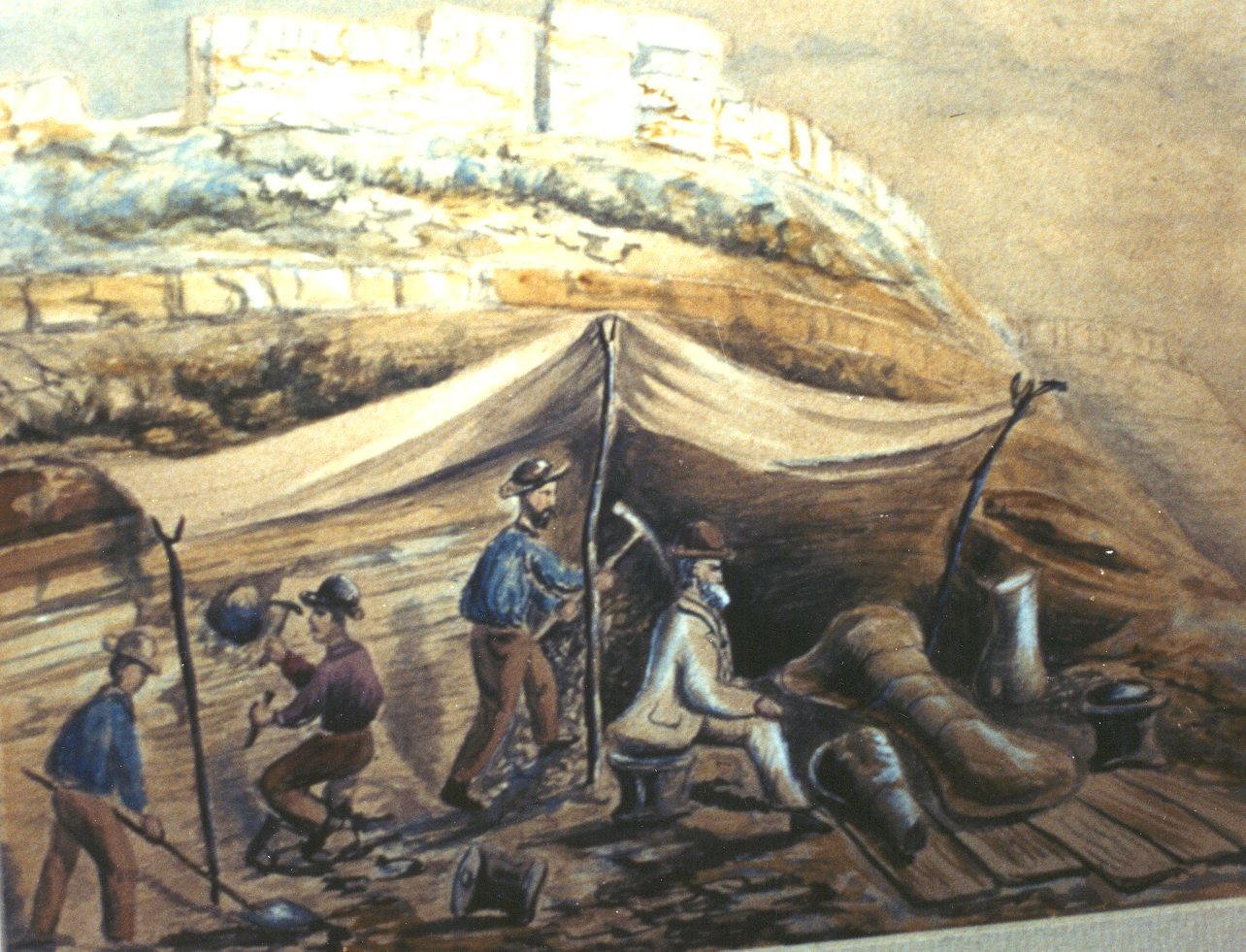
Quarry #10 near Morrison, or Clay Saurian #1, as drawn by Rev. Arthur Lakes.

One hundred forty years ago this month, Morrison entered the history of paleontology in an impressive way, with the discoveries made by Rev. Arthur Lakes on the hogback north of our small town.

On a Tuesday in late March 1877, a young professor made a discovery at what is now Dinosaur Ridge, near Morrison in Jefferson County, Colorado. This discovery transformed American geology and started a revolution in our understanding of dinosaurs. It also sparked a dinosaur “gold rush” that led the great scientific institutions of the East to turn their sights west. The fabulous wealth of such men as George Peabody, Andrew Carnegie, and Marshall Field was unleashed in a quest for the biggest and most bizarre dinosaurs to fill their museums. —Hunt, Lockley, & White, 2002
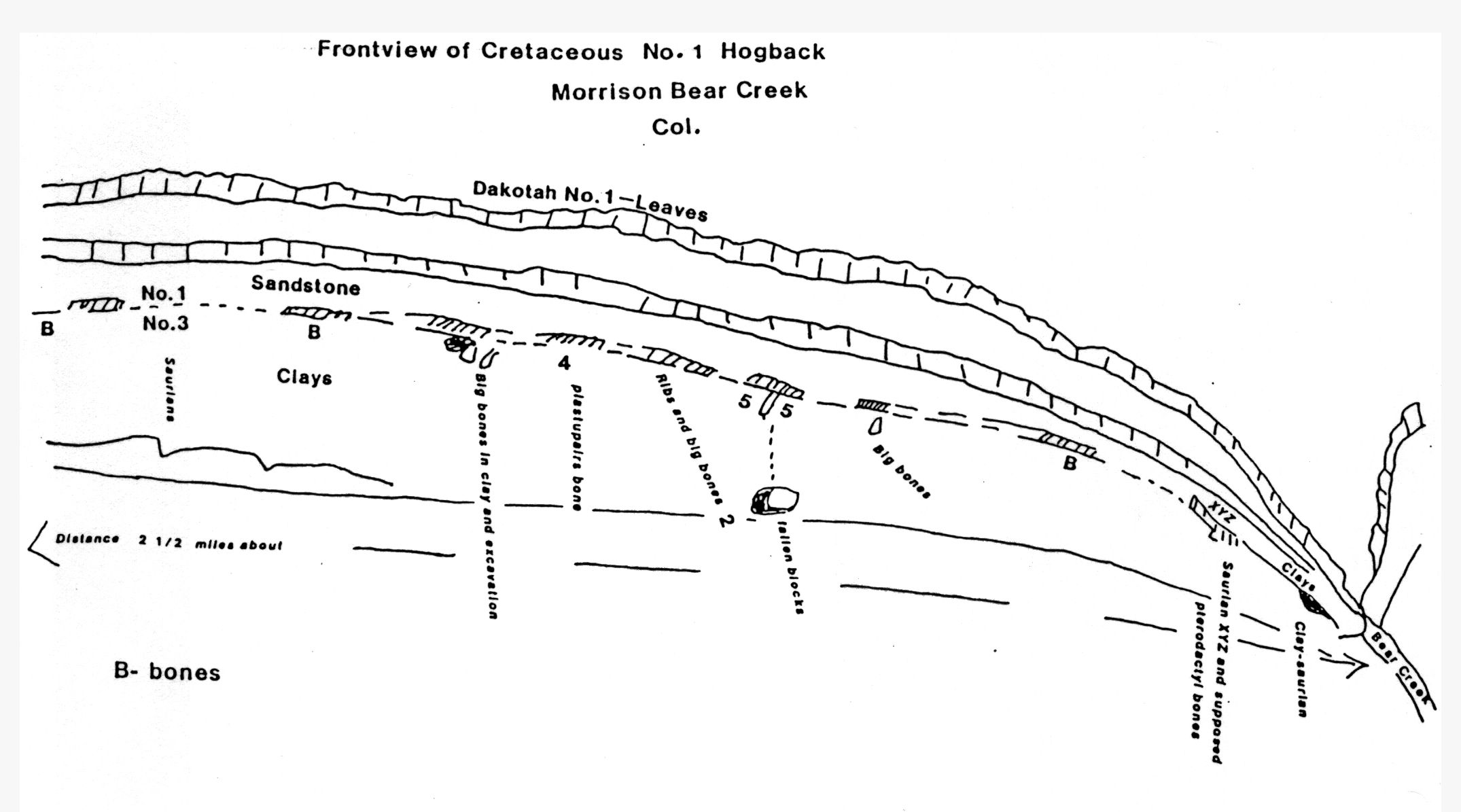
Arthur Lakes sketch of the quarries along the west slope of the Dakota hogback, from a letter to in 1879.

Ultimately, Lakes agreed to send the dinosaur bones discovered at Morrison to Professor O.C. Marsh at Yale’s Peabody Museum. For the next two years, Lakes and colleagues (including Benjamin Mudge, in white in above drawing) continued to send bones and reports to Marsh documenting their work at 14 sites along the hogback. Lakes also recorded their activities in his diaries, leaving us an extensive historical record of Morrison’s part in the “Bone Wars” of the late 19th century.

Lakes sent his first letter to Marsh on April 2nd, 1877. This letter told Marsh about the discoveries and their position in the sequence of rocks. He included good drawings of two partial bones and a detailed sketch of the geology of the area now known as Red Rocks Park and Dinosaur Ridge. —Hunt, Lockley, & White, 2002

Only four of the quarries yielded significant discoveries. Quarry #10, the Clay Saurian, is known for Apatosaurus ajax (YPM 1860). This site near the southern end of Dinosaur Ridge was relocated in 2002 and has been worked since then by teams from the Morrison Natural History Museum. Based on Lakes’s sketches of the hogback, his diaries, old photos, and field surveys, the location of Quarry #1 was identified in September of 2009 (Ghist & Simmons, 2010). The rediscovered quarry site was named a county landmark in 2014. This and other sites along Alameda Parkway are managed and interpreted by the Friends of Dinosaur Ridge.

National Natural Landmark Plaque on Dinosaur Ridge

The entire “Morrison Fossil Area” was named a National Natural Landmark in 1973. In 2011, the Landmark was expanded to include Late Cretaceous track sites near Golden, and is now called the “Morrison-Golden Fossil Area.”

References
Ghist, John, Simmons, Beth. 2010. Rediscovering Arthur Lakes’ Historic Lost Quarries at Dinosaur Ridge (Morrison, Colorado) Presented at 2010 GSA Denver Annual Meeting, 1 November 2010.)

Hunt, Adrian, Lockley, Martin and White, Sally. 2002. Historic Dinosaur Quarries of the Dinosaur Ridge Area Friends of Dinosaur Ridge and the University of Colorado at Denver Trackers Research Group.

JCHC. 2014. Preserving Prehistory: Friends of Dinosaur Ridge, Meyer Award for Historic Preservation. In Historically Jeffco magazine, Vol. 35: 39-40. Jefferson County Historical Commission.

JCHC. Dinosaur Ridge Describes Dedication of National Natural Landmark in May 2004.

Horton House Fire Update

Friends and neighbors gathered at the Horton House yesterday afternoon to board up the historic home after the destructive fire. Lumber was donated by Home Depot.

Workers at the Horton House after fire, October 1, 2015.

Workers at the Horton House after fire, October 1, 2015.

Boarding up the sunroom at the back of the Horton House.

Boarding up the sunroom at the back of the Horton House.

The Town of Morrison sent out this report:


The Horton House Bed & Breakfast in Morrison, Colorado, was built in the 1870s. The house was owned and lived in by Lila Horton. Many guests have stayed there while visiting Morrison and have had the chance to experience the historic building in all its beauty.

This morning the historic and popular bed and breakfast caught fire–while everyone did get out okay, the house was considered a total loss.

Lila does not have insurance and has created an account to help with the losses–everything from historic items dating back over 100 years to numerous personal keepsakes.

Please help Lila to rebuild! Go to: GoFundMe if you can help.


In the late 1800s, this was the dwelling of James and Amy Abbo; James ran Abbo’s Livery nearby on the property. The house was later occupied by Dr. Frank Luce and his family; he was Morrison’s “horse-and-buggy” doctor in the first half of the 20th century. From 1945 to 1973 the house was a Mexican Restaurant, El Gallo Tuerto, one of the first in the Denver area. Additions have been made over the years.

The photos below were captured by Kenny Noble Cortes, of KLOV Radio, during the fire.

Fighting the Horton House fire, October 1, 2015. Photo courtesy Kenny Noble Cortes.

Fighting the Horton House fire, October 1, 2015. Photo courtesy Kenny Noble Cortes.

Fighting the Horton House fire, October 1, 2015. Photo courtesy Kenny Noble Cortes.

Fighting the Horton House fire, October 1, 2015. Photo courtesy Kenny Noble Cortes.

Horton House Fire brings Painful Loss to Morrison

Historic Horton House

Historic Horton House in Morrison

Early this morning, the Horton House Bed and Breakfast was destroyed by fire! Heartbreaking photos indicate the extensive damage to Lila Horton’s childhood home, which she has run as a bed and breakfast for many years. (See “historic hospitality,” courtesy of City and Mountain Views.)

Lila has been at the center of Morrison’s history for many years, carrying on the preservation efforts started by her mother, Reenie Horton. She has owned and restored several historic buildings in town, some of which survive on the property.

If you have enjoyed staying at the Horton House, or just appreciated its quaint charm in a quiet corner of Canon St., please consider helping Lila and her family weather this tragic loss. A GoFundMe account has been set up to help Lila replace basic necessities and find a place to stay.

Historic Happenings in Morrison

Tucked behind the hogback at the edge of the Great Plains, along the banks of Bear Creek 20 miles west of Denver in Jefferson County, Morrison is known as “the nearest faraway place.” The spectacular sandstone outcrops of adjacent Red Rocks Park, with its amphitheater built by the Civilian Conservation Corps in the 1930s, draw visitors from around the world to the tiny community with a population of 430. Morrison is known for the 1877 dinosaur discoveries of the first Stegosaurus, Apatosaurus, and Allosaurus, as well as the annual Mile-High Nationals drag race at nearby Bandimere Speedway. Survival has been the watchword throughout Morrison’s 140-year history, including disastrous floods and fires, the arrival and demise of the railroad, the economic ups and downs of tourism and mining, as well as the present-day pressures of urban growth. This website commemorates the willpower and pioneer gumption to survive that have been handed down through the families and businesses of this untarnished gem.

Morrison’s stories are accompanied by selected vintage images, collected by the Morrison Historical Society. Many were gathered in the 1970s by pioneer historian Lorene (Reenie) Horton. New images shared by local families supplement her work, along with selected photographs from other archives.