Water Swirled Through Morrison Without Warning, Witness Says
By ROY DENBOW As Told to George Burns, News Staff Writer Rocky Mountain News, Sept 3, 1938, pages 1-2
MORRISON, Sept. 2. 1 was standing in front of the Morrison Garage when the very heavy rain started. It wasn’t so bad at first so I stayed there and watched it. All of a sudden the water started rolling down in waves from Mount Vernon Canon.
Before I knew what was happening, I was out in the middle of the street and up to my hips in water. There were about eight or 10 persons standing in front of the Mount Morrison Cafe. I hollered to them to run.
I don’t know what they did or what happened to them because the water kept getting deeper and I found I was in it up to my chest. Things started coming at me. An auto trailer, three automobiles, and a truck came pouring out at me on a wave of water that swept through the rear of the garage and out the front.
I was so busy dodging the cars and trucks and stuff that I didn’t have any time for the logs and boulders that were tumbling in the water. Then I saw a gasoline truck come rolling out of the garage with Jim Walpool trapped in the cab.
So Bob Smith and Gilbert Lusce [Luce], who were near the garage, and I waded through the water and pulled Walpool out of the cab just a second before the truck was swept across the road toward raging Bear Creek. Walpool was about half drowned. We high-tailed it to high ground back of the town.
It was 30 minutes before the water went down enough for us to come back to town. I was in the flood in 1933, but this was three times as bad. I was eating supper in my home during the 1933 flood when a wall of water came down Bear Creek and poured into the house. I didn’t waste any time that night. I just beat it right up on the Hog Back and waited for the water to go down. But this flood was far worse than that one.
…one of the most devastating floods last Friday afternoon [7/7/1933], ever to visit the Bear Creek water shed in Jefferson county. A cloud burst at about 1 o’clock sent a wall of water down Saw Mill gulch leading to Bear creek at Idledale and another raging torrent down Vernon creek, which empties into Bear creek at Mt. Morrison. At Idledale the flood waters were estimated to have been 200 feet wide and with a depth of eight feet as the torrent swept into Bear creek. At Mt. Morrison the Vernon creek water reached a height of about fifteen feet as it swirled down in the narrow passage between business houses and out onto the Main Street and on across to Bear creek, which had already assumed flood stages by the surging water emptied into the creek at Idledale. …
A victim’s gratitude 7/13/33: In the midst:
Threshing water coming down Mt. Vernon caught us in the alley before we could reach the Cliff House. We made it as far as the board fence and held on until the fence gave away, as also did my sister-in-law. I caught her around her neck with my right arm and with my left arm strove to work our way to some sheds, fighting desperately to keep from going into the current which would have carried her into Bear creek.
We were only in the midst of it a few minutes but it seemed ages as I frantically fought to save my sister-in-law from going under the raging water. My strength was exhausted just as the men came to my rescue. So again I wish to extend my gratitude for their assistance.
From a newspaper account of the events of July 24, 1896:
Friday evening the fierce black clouds in the west brought early darkness. A light rain drove the people into their houses, lamps were lighted, and the children were put to bed. Up town there were the usual loiterers in the stores and some stood by the open doors watching the rain fall. The air was calm and still and there was nothing to even indicate the change that was coming.
Suddenly a sullen roar, resembling thunder, yet more sustained, so that none mistook it for that noisy sound. Among those in the store, several had heard that sound before and knew its meaning. Their faces paled as they shouted, “A flood, a cloudburst!” Around the bend came the monster, appearing as a log-crowned curling wave ten feet high. It did not look like water, having more the appearance of a solid mass, dark as night, with a luminous crest.
It seems to move with almost lightening-like rapidity. When it reached the bridge above town, the first object that seemed to be in its path, there was no clash; the bridge hesitated but an instant, moved slowly from its piers, then went rolling end over end down past the depot until the railroad bridge was reached. Here there was a moment’s resistance, but the water simply paused to wait for reinforcements.
Following the 1896 flood, the Rocky Mountain News reported that
Less than two days ago Morrison was considered the most delightful, quiet and peaceful summer resort in Colorado. Today [July 26, 1896] it is a mass of wreckage and ruin, the people panic stricken and a number of those who were inhabitants are either lying at the morgue awaiting burial or are buried under an enormous mass of debris somewhere between Denver and Morrison, perhaps never to be found until Gabriel sounds the last trumpet on the day of judgement.
A day later, an update appeared: “Morrison Will Live”
The disastrous flood at Morrison has caused the active circulation of a rumor to the effect that the town would be abandoned by the people there. There is no reason or truth for the foundation of such a report. While Morrison has received a severe blow, she will recover promptly and there is not the slightest danger of a repetition of such a flood, for several years at least. …
This first-person account by Francis Kowald, S.J., describes one of many floods to strike in the lower reaches of Bear Creek Canyon and Morrison. Due to space constraints, it was not included in the 2014 issue of Historically Jeffco devoted to floods.
The writer of this short sketch happened to be an eye-witness of one of such frightful floods, which fortunately took place during the bright day-time. A cow-boy herald gallopped [sic] along at break-neck speed ahead of the swiftly on-rushing flood, some twenty minutes before its arrival and shouting at the top of his voice as he bounded along the road-bed, gave kindly warning, like another Paul Revere, to all residents housed on the banks or living close to the bed of the creek. They who were surprised and caught in the canyon itself during the storm, abandoning every kind of vehicle or truck they had, were obliged to scramble up the rugged mountain-sides, to save their own lives as well as their beasts of burden, if possible and time allowed in such an emergency.
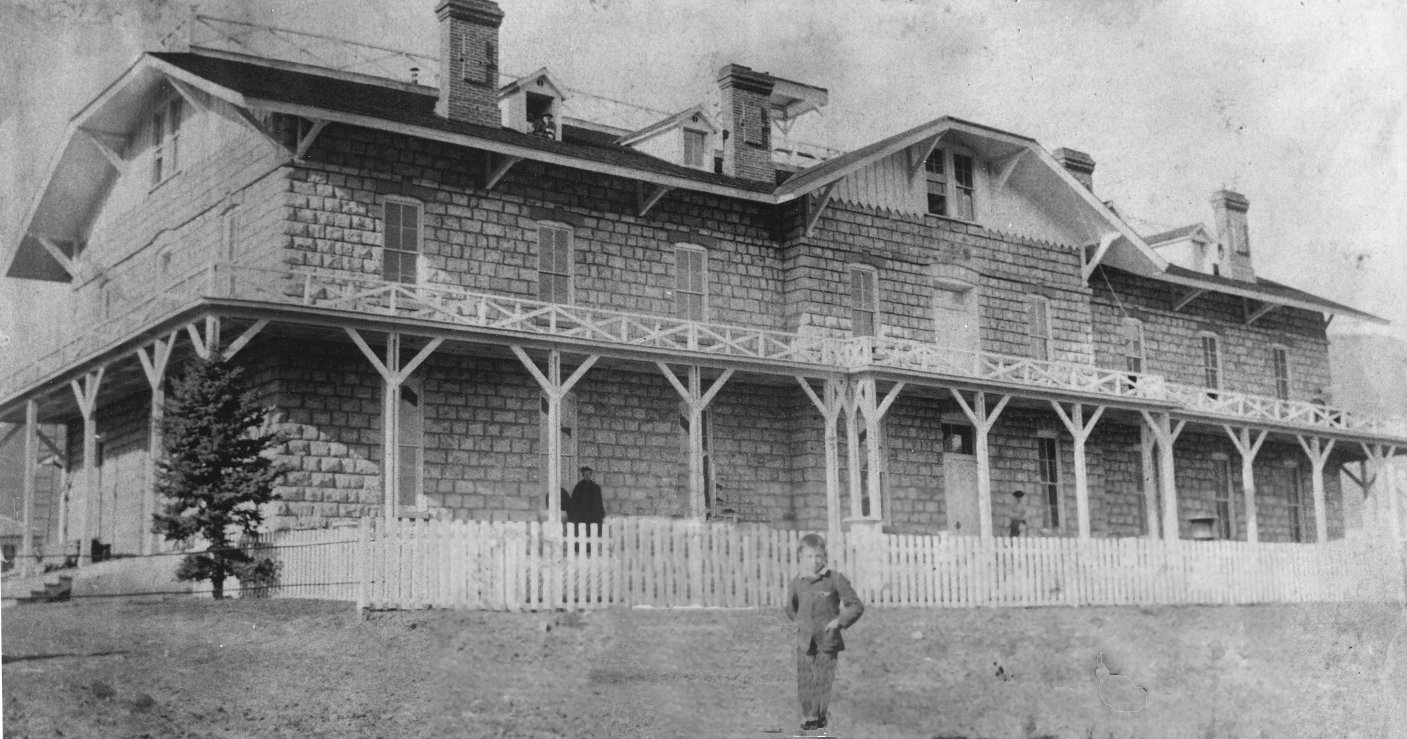
Jesuits and students watched the flood described here from the porches of Sacred Heart College, as it was known from 1884-1888. This building, the Evergreen Hotel, later the Swiss Cottage, built by George Morrison for Governor Evans in 1874, was known by many names through the years.
This great flood occurred at the beginning of July during the third year vacation-days.(1) The lightning and thunder-storm had spent its fury and the sun appearing once more between the straggling clouds of the recently overcast and lowering sky, was again shining bright and peaceful. The creek was yet low, with scarcely one [foot] high running water in its bed, as we all at the College could notice, when upon the warning given, we had rushed to the porch to witness the terribly strange and ominous spectacle.(2) A few more moments of wild excitement and anxious dread and expectation, and behold! the onrushing torrent hove in sight. On its swollen crest of some three feet abrupt height, it carried the wreckage of some ten small wooden bridges, later rebuilt with reinforced cement, which had been erected for crossing and recrossing the creek along its nine mile circuitous course through Bear-Creek canyon from the village of Evergreen to the town of Morrison. Here it met the ponderous, twice planked wooden bridge, the largest of them all, about 30 ft. long and 10 ft. wide.(3) Here the torrent was arrested for a while in its impetuous course, not more than a minute or thereabout, in trepidation, as it were, of what it next would do, while it rose and swelled in size and piled up its ever augmented debris upon debris, until with a loud snapping and crashing of timbers like the report from a heavy gun, it bodily dislodged and lifted the entire bridge from its firm and heavy moorings and supports on either side and then with a mighty swirl turned and hurled it lengthwise like a huge arrow shot from a powerful bow with lightning speed down the fiercely raging and seething stream.
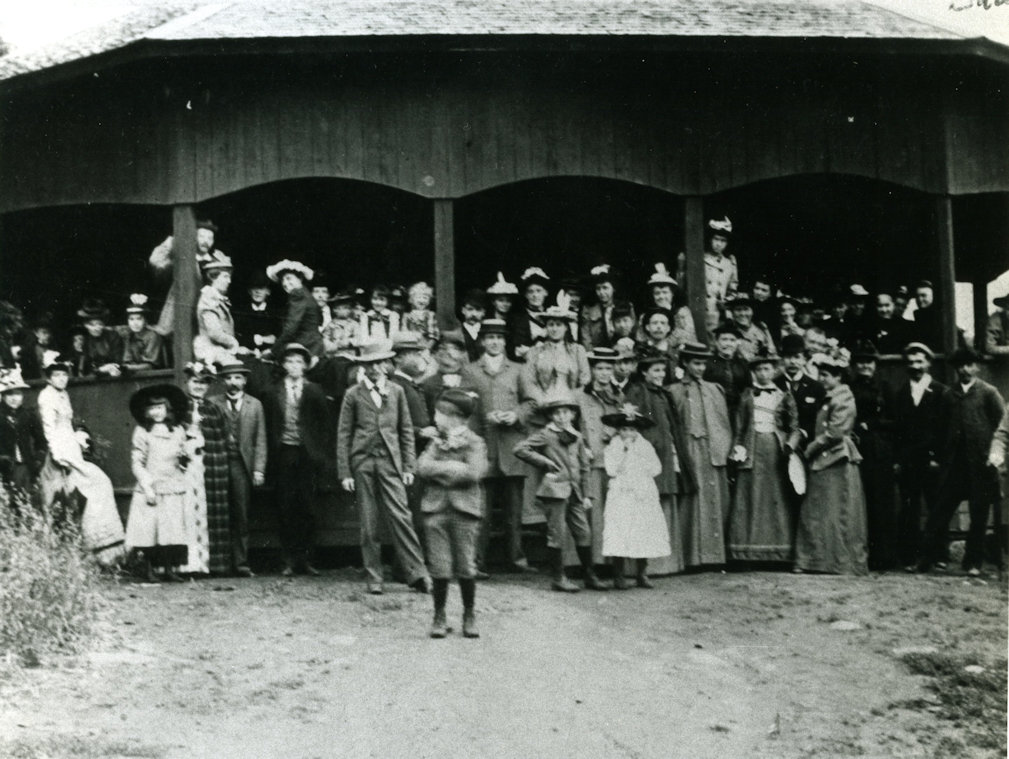
The Lorelei Park dance pavilion in downtown Morrison.
A moment later missing the Depot, it hit and demolished the wooden, octagonal, roof-covered Pavillion [sic], measuring some 15 ft. in diameter and some 12 ft. in height and built some 10 ft. above the creek, which was used as a grandstand for dancing, brass-band exhibitions and other amusements for the town-folk gathered together on certain festivals as Shrove Tuesday of carnival, Decoration-day, Fourth of July, All Hallows and the like, as it was centrally located in the town. With this accumulated wreckage the darting current nearly undermined the foundations of the adjacent Railroad Station and a few yards beyond carried away some 90 ft. of rail-road track with its steel rails still fastened to the ties or sleepers end at the first curve of turn tossed it out of the water and through the garret-floor and roof of a hut, inhabited by an elderly couple, without the least injury to their personal selves. It next spent its rage against the solid masonry and stone pillar-supports of the Railway-bridge across the creek near the gorge east of the town, loosened several flags, measuring 2 x 4 x 8 ft. and weighing tons apiece, and flung them yards away upon the banks below. After a good deal of further damage to cattle, hogs, poultry and a few horses, all of which were drowned in the lowland fields, it hurried along the plain, till finally it emptied or debouched into the South Platte River near Denver, some 16 miles distant toward the east. Fortunately no human lives were lost on this occasion, though a number of previous and subsequent cloudbursts claimed their sad toll of fatalities also among the lowland inhabitants along the banks of Bear-Creek.
Notes: (1) As the college started in the fall of 1884, we believe the “third year vacation-days” would indicate July 1887, assuming accurate recollection on the part of the author who was writing this account in about 1935. Except where noted in brackets, text and punctuation and spelling are as in the original version. (2) The large building housing Sacred Heart College from 1884 to 1888 sat on a bluff about 200 feet above the normal level of the creek. With few trees at that time to obstruct the view, it is likely that the observers had an excellent vantage point to observe this event. (3) This description likely refers to the bridge at South Park Avenue, which was the main route south of town toward Turkey Creek and, eventually, South Park.
Excerpted from (with paragraphing added): A BRIEF HISTORICAL SKETCH AND SOME REMINISCENCES OF The SACRED HEART COLLEGE Conducted by the Jesuit Fathers At Morrison, near Denver, Colorado From October 1884 till June 1888. From pages 11-13 of typed manuscript housed in Archives and Special Collections, Regis University.
More information on Morrison history is available at Jeffco Archives. Contact Archivist Ronda Frazier (rfrazier@jeffco.us) for access to the Morrison History Collection.

 Morrison History
