Author Archives: SLWhite

Assorted Morrison Memories

We love hearing from readers, and we always learn something new about Morrison’s history! Here are some stories from comments made in recent years. We invite you to add your own comments to any posts that strike your fancy.

Yvonne wrote (in 2022):

I was born (1940) in Evergreen where my family had emigrated in the 1860s and homesteaded. Morrison was part of the Evergreen life and history. My father (b. 1907) talked about skating on Bear Creek all the way to Morrison. A stagecoach served to carry passengers between the two towns. I was told that my grandfather’s ranch was the source of Kosher cattle which he would drive down the Canyon to the railroad where they would be turned over to the Jewish community for Denver. I remember well the stops at the Tabor Bar and the town around it, since it was the “halfway” point in the (then) long drive to Denver. 


From Jeannine (in 2022):

James Wilson Haworth along with his wife Alverda Rice and infant daughter Arminta left Springfield Missouri and moved to Morrison in 1875. They sold their drugstore in Springfield and joined a wagon train heading west to Colorado. They set up a drugstore in Morrison and lived there until 1880. Two sons were born to them there. Julius Ross Haworth in 1876 and Samuel Elmer Haworth in 1879. Their little daughter Arminta passed away Nov.3 1875. She is likely buried there in Morrison. In 1880 the family moved on to Pueblo Colorado and set up another drugstore. Their daughter Alma was born there in August 1880. Living very close to the Haworths was Alverda’s widowed Mother Henrietta Lewis Rice, along with her three children. The whole extended family eventually moved farther west with the wagon trains into Oregon and Idaho where family still reside.


From Linda (in 2020):

Willow Ridge Manor, now located in Morrison [on Hwy 8 near The Fort], was originally a private home located on Old Kipling Rd. My grandfather, George Alexander Allen bought that house and renovated in 1915. The house sat north of the land he donated to build the 1st school on Bear Creek, which was originally called the “Montana School”. My grandfather met my grandmother, Myrtle Griffith, when she came to teach there in 1917, and they were wed in 1919. My father, Jack R. Allen, was born in that house in 1924. They sold the property in 1929.


From Rod (in 2019):

My great grandmother was Martha Ann (Bergen) Greene, daughter of Thomas Cunningham Bergen and Judith Roe Fletcher. Her father, who founded what is now “Bergen Park” in 1859, eventually moved down Bear Creek to farm just south of Morrison in the early 1870’s. He was the first to dig a couple of ponds for irrigation and cultivate a fish business there. The two small ponds are yet on the T.E.V. Edelweiss outdoor Facility property. My great grandmother was married there on Hogback Ridge 11 June 1876 to Thomas Henry Greene. They eventually moved back to Hopkinton, RI in 1880 (his birthplace) to care for ailing family.

In 2008 my brother and I travelled to Bergen Park, Idaho Springs, and Morrison tracing the Bergen family sites. With the help of a 1928 photo album of my grandfather’s, who had taken his mother back to Colorado in 1928 to visit with her brother, William Henry Bergen (whom she hadn’t seen in 48 years) and four generations of his family there … my brother and I were able to locate Thomas C Bergen’s headstone in the Old Morrison Cemetery just above the town (and just below The Red Rocks Park).

We also traveled up “Oh My God” Road, off the Virginia Canyon Rd out of Idaho Springs to Central City. It runs up through Gilson Gulch where my great grandmother, Martha Ann Bergen, spent two years running a boarding house for the Gilson’s while my great grandfather Thomas had staked and was mining two claims. Martha’s first child was born up there on Christmas Day 1877. In 1880 they sold their claims and went to Hopkinton, RI, where they raised eight children and were both buried. My great grandmother lived until a week shy of her 100th birthday in 1956.
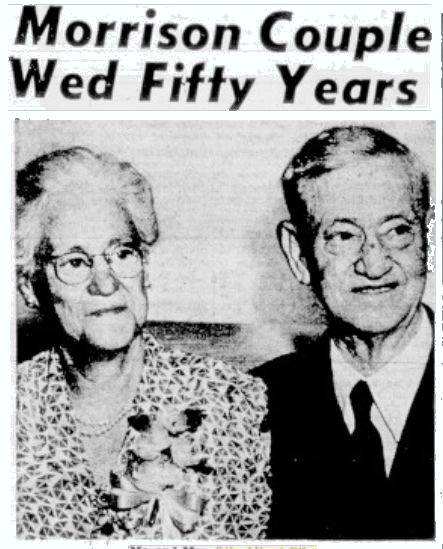
Mollie Dyer Pike and Otis Albert Pike

Mollie Dyer moved to Morrison July 3, 1902, when she married Otis Albert Pike. “That’s why we selected her,” Alex Rooney said in 1954 when she was elected Queen of Morrison’s Pioneer Days celebration. “Her husband is Morrison’s oldest surviving pioneer. She’s practically a native herself.” It only took her 52 years!

Born in Missouri Jan. 8, 1883, Mrs. Pike moved to Denver with her parents, Mr. and Mrs. Thomas Jefferson Dyer, in 1889. In 1900 she moved with her father to Cripple Creek, where he started a mercantile business. In Morrison she was active in town life and a community asset with many accomplishments to her credit. Mrs. Pike was a lifelong Democrat, the Rocky Mountain News reported, and served as superintendent of the Morrison Methodist Sunday School. She was also secretary of the school district 12 years and president of the school board four years, a leader in PTA, active in Red Cross and child welfare work, and a leader in salvage and war bond work in two World Wars. In 1954, she was named Queen of Morrison’s Pioneer Days event. For 35 years, she also wrote a column for Jefferson County weekly newspapers.

Mollie Dyer Pike and Otis Albert Pike on the occasion of their 50th wedding anniversary, July 1952.

Mollie’s husband, Otis Albert Pike (1877-1955), was a Morrison native and a grandnephew of Gen. Zebulon Montgomery Pike, for whom Pike’s Peak is named. His parents were Anderson Gage Pike (1830-1899) and Hannah Fenton Pike (1840-1887), pioneers who settled in Morrison sometime after 1864, leaving three children behind in Westview Cemetery in Kirkville, Iowa. Otis served the town as its Mayor for 14 years (circa 1930s) and owned the Pike and Perry Mercantile.

Otis and Mollie had three daughters, Esta Pike Burke (1903-1991) of New York City; Alberta Pike Boyd (1905-1975), owner of Denver’s Vogue Theater; and Genevieve Pike Moore (1907-1974), an employee of the Defense Department in Anchorage, Alaska. The Pikes are buried in the Morrison Cemetery; a nearby stone memorializes their daughters.


The Rocky Mountain News (Daily), Volume 95, Number 210, July 29, 1954; RMN, Volume 93, Number 188, July 6, 1952; RMN, Volume 96, Number 354, December 20, 1955.

Memorable Buffalo Barbecues

From reader Yvonne (in 2022):

One of the events that took our family to Morrison (other than travel to Denver) were the buffalo barbecues, sponsored (if I remember correctly) by the volunteer fire department, which was the beneficiary of one of the “surplus” buffalo from the group raised on the property now bisected by I-70. [Genesee Mountain Park, part of Denver Mountain Parks] The long side of the road across from Tabor Bar was a dirt parking area, just west of the quonset hut, and a huge, huge hole was dug in that parking lot where the fire was built and the buffalo barbecued. I don’t know for how long, but the result was a huge feast where the whole town turned out. Morrison has changed so much, but I never go through there without looking at the ghost of the parking lot and remembering the barbecues!


Buffalo herd at Genesee Mountain Park. Cows and calves, spring 2015. Photo by SL White.

The rest of the story: By 1938, Denver’s buffalo (or bison) herds had grown to numbers that threatened to overwhelm the land available for them. The city started donating or selling extra animals– the previous year’s calves– to interested parties, from individuals to organizations and restaurants. By the 1960s, they had set up a formal auction every spring; money raised helped balance the cost of maintaining the herds.

Another Morrison Murder, 1928

Reader Luann commented on the “Deadly Duel” post to let us know about another historic murder in town. She writes:

Another illustrious story for consideration involves the shooting of my grandfather James William Hair by John Anderson at the pool hall in July of 1928. My grandfather was with the Secret Service so his shooting and all that followed was headline news.

Sgt. Leo, of the Morrison Police Dept., researched this one a few years back. Here’s the outline, but you can read his full story here (pdf), as reported in Morrison’s Hogback News, Sept 2018. The story was followed by area newspapers for months after the event.

Operative James Hair was engaged in an outdoor shooting match in downtown Morrison with James and Perry Knoll on July 12, 1928, when the men were approached by John Anderson, a bootlegger from Denver. Anderson was on parole at the time, on a charge of operating a still. He pulled a pistol and shot Hair in the chest, then disappeared into crowds emerging from local businesses. Anderson was captured and sentenced to life in prison. He was later granted a new trial and found guilty of manslaughter, with a one-year sentence. A later trial on the still charge added two years to his sentence. His wife Iris avoided being charged as an accomplice, and divorced him soon after.

Operative Hair was 34 at the time of his death, a University of Colorado graduate and World War I veteran who had joined the U.S. Secret Service two years earlier. He left a wife and two children.


Sgt. Leo was unable to pin down the location of a downtown shooting range, but it sounds as though it had to be near the town’s main intersection at Bear Creek Avenue and Stone St. The local businesses mentioned were Pike & Perry Mercantile (& dance hall) and Peinze’s Grocery Store, which occupied the two corners. Across the street was the large parking lot, formerly the railroad depot, used for various town activities. I’d guess any “outdoor shooting range” close to downtown would have to be in that area. Does anyone have better information? If so, please drop a comment below.

The Quaintance Family

Another tidbit retrieved from an earlier version of this website.

No more than an introduction to this historic local family can be attempted in this small space, but the Quaintances deserve a significant place in Morrison’s history, as they have in Golden, where Brough Quaintance had established himself even before Adolph Coors arrived. His family built the Castle Rock Scenic Railway up the west side of South Table Mtn., an enterprise that was later doomed by the arrival of the automobile, and the building of a road, the Lariat Trail, up nearby Lookout Mountain.

Mary Ross Quaintance, for whom our small downtown park(1) is named, was 14 years old and attending the old Morrison schoolhouse the day school was recessed to allow townsfolk to hear soprano Mary Garden sing at Red Rocks. That was in 1911, long before Denver acquired land for the park from her father, John Ross, in 1927 or built an amphitheatre there (1936-1941). Mary remembered visionary John Brisben Walker, who sometimes came to the Ross home for dinner, and she was home from school, sick, the day Walker’s castle on Mt. Falcon burned.(2) Mary Ross married a son of Brough Quaintance, Arthur D. Quaintance, an attorney in Golden and Denver, in 1919. Mary Ross Quaintance died in 1980(3), but is well remembered for her remarkable knowledge of the history of our area.

John Ross, Mary’s father, was one of Morrison’s early businessmen. The stone building next to our new park was his hardware store back in the 1900s, and the family lived in the house at 106 Stone St. that is now occupied by Professional Meetings, Inc.

Reprinted from The Town Crier #4, July 1999
Published by the Morrison Action Committee


(1) Quaintance Park was a small, short-lived “pocket park,” built by townspeople from an unused partial lot tucked between the Ross Hardware building (#11) and the Tom Lewis Home (#10).

(2) These stories are reported by Georgina Brown, who interviewed Mary for her book Shining Mountains, published in 1976.

(3) Mary Ross Quaintance dies at 82 (Canyon Courier Feb 13, 1980)
Mrs. Mary Ross Quaintance, whose family has owned Tiny Town for approximately half a century, died at her home in Golden on Friday, Feb. 1, She was 82. Mrs. Quaintance, the widow of Arthur O. Quaintance who died in November, 1959, was born Aug. 8, 1897 in Morrison, the daughter of longtime Morrison residents, John and Mary Ross. Survivors include two daughters, Mrs. Maryanna Q. Johnson of Lakewood and Mrs. Leo (Patricia) Q. Bradley of Golden; four grandchildren and one greatgrandson.

Historic Floods in Morrison

Morrison is a low-lying town at the confluence of two drainages, Bear Creek and Mt. Vernon Creek. With a watershed stretching to Mount Blue Sky (historically Mount Evans), the town has experienced its share, maybe more, of devastating floods. Here are reports from a few of them over the years of its settlement.

An 1880s Flood in Morrison

July 24, 1896: A newspaper account

Aug 7, 1906:
“Bear Creek again assumed flood proportions, doing much damage but no lives were lost.”
—Jefferson Co. Graphic

Sunday, Aug 30, 1925:
“… many picnickers were in the canon. Two or three bridges were washed out, automobiles were caught in the water and washed into the creek, but minor damage was done the road, and no loss of life was reported.”
—Jefferson Co. Graphic

1933: A Victim’s Gratitude

September 2, 1938: Eyewitness Describes Rescue

Construction Boom Hits Morrison

Red Rocks Vista Drive, 1962

From the Morrison Messenger, June 2002
Photos courtesy of Jack Jones

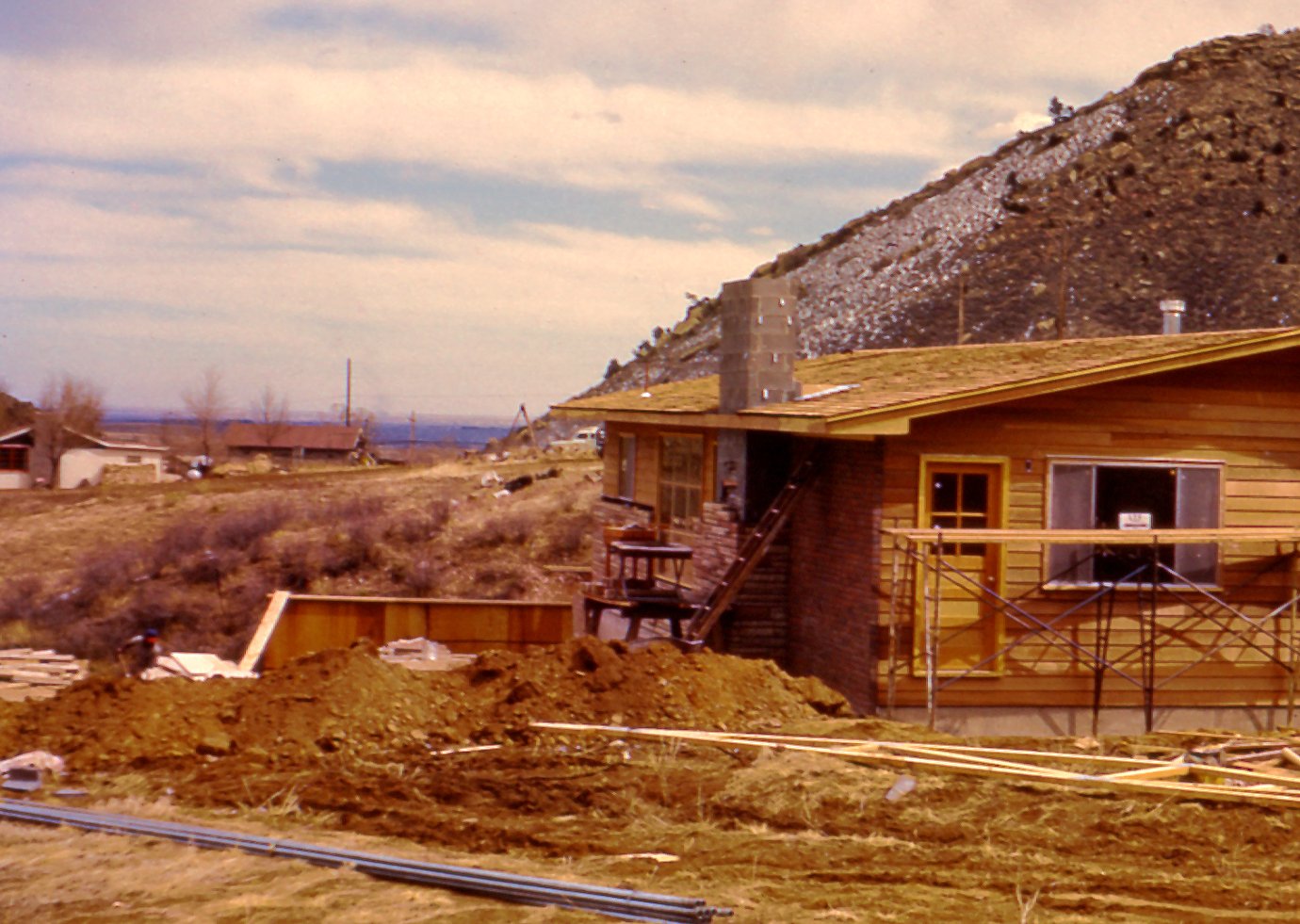
Carl Peinze, real estate agent and former owner of Peinze’s Grocery, continues to build in the new residential subdivision he’s developing in Morrison. Peinze acquired the property and sold several lots during the 1950s, many of which have already had homes built on them. Several other homes are in progress, including a new house at 152 Red Rocks Vista Drive.

Pickup trucks ply the streets, and construction trailers are everywhere, as workers struggle to complete the buildings. The aptly named street, though lacking in trees and other landscaping, affords remarkable views of Morrison’s closest and most celebrated scenic attraction. For the first time in a century, Morrison’s population will swell as the new homes are completed.

View of Red Rocks from Red Rocks Vista Drive, 1962
with houses under construction

Cowboy Celebration Revisited

Part 2: Documenting the Morrison Cowboy Celebration
(see Part 1: The First Morrison Cowboy Celebration)

Out of Morrison’s 150-year history, you could easily miss the Cowboy Celebration, which ran for only five years, 1996-2000. This month, we’ve spent some time refreshing our memories of these stirring days, when western singer-songwriters and cowboy poets graced the stage at the Morrison Town Hall. Thanks to the efforts of videographer Donna DiGiacinto, who recorded the 1996 and 1997 events, we can even give you a sample of what it was like to be there in person.

Historical Morrison Cowboy Gathering 1996 -97

Some of our performers have passed into history, others we’ve lost track of, and some you can find still working their trade today, sharing stories and songs of the Old West. Donna captured rare footage of legendary Pete Smythe at the 1997 celebration; he died in 2000. We lost Sean Blackburn, of mustache and musical fame, in 2005; Bill Barwick and Liz Masterson followed in 2017. Poet Dennis “Slim” Fischer died in 2023. We honor their legacy, and are happy to bring you a taste of their time on the Morrison stage.

Screenshot of the Cowboy Celebration home page, as displayed on the Morrison website in 2002.

We’ve also been retrieving the story of the celebrations, as it was reported on Morrison’s website at the time. Thank you, Internet Archive, for keeping these old pages accessible! Links below open in new tabs.

Morrison Cowboy Celebration Homepage, as of 2002 (pdf)

Selections from the 1996-97 Celebrations (video, 2:42:38 minutes)

1996 Celebration– a few photos (by Mary Jordan, pdf)

Review of 1998 Performances (pdf)

Summary of 1999 Celebration and Review of 1999 Performances (pdf)

Preview of Celebration for 2000 (pdf)

Deadly Duel Fought in Morrison

(Morrison pioneer justice, or Ned kills Ed kills Ned, 1879)

Morrison Pioneers to Have Their Say

“The old folks will get the opportunity they’ve been looking for -- a chance to have their say– at Morrison’s unique Pioneer Day celebration, July 30,” reported the Rocky Mountain News, July 17, 1949. Among the highlights of the event:

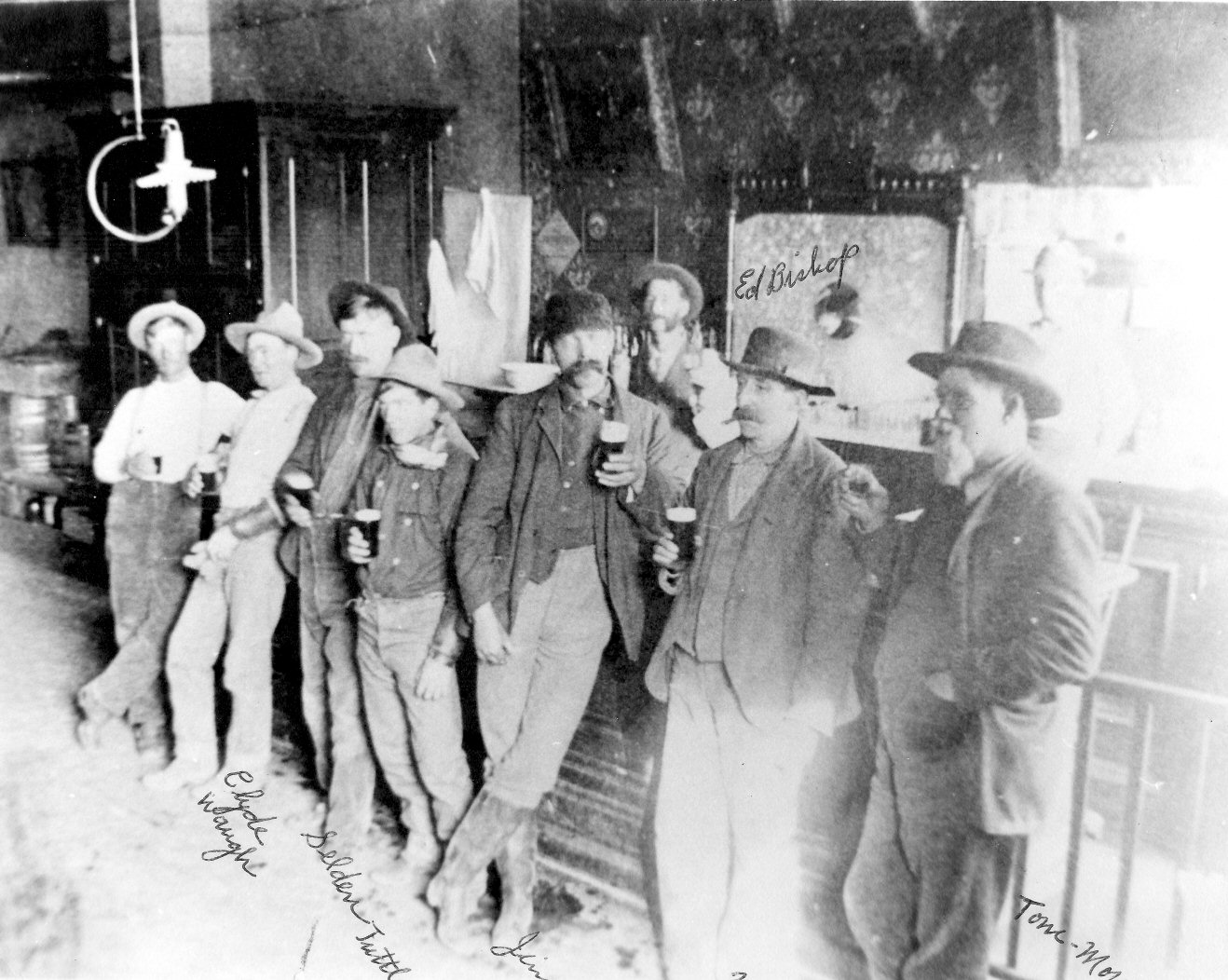
A quiet evening at the Schrock Saloon.

And there will be a dramatic story of the “Deadly Duel Fought in Morrison,” as newspaper headlines proclaimed. The duel took place in 1879 when Ed Sunderland was playing pool in Schrock’s Saloon at Morrison. Ned Pratt entered and started shooting out the lights, an exercise that caused Ed to descend upon him with a billiard cue.

One thing led to another, and Ned shot Ed twice in the forehead. The town marshall happily was close by and rushed in to charge Ned with murder.

But at that moment Ed raised himself on one knee, held his left hand over his wounds, and with his right hand sent a .45 caliber bullet crashing through Ned’s midsection. Ned died instantly, and Ed followed him 15 minutes later.


NOTE that above is a story passed down and written some 60+ years after the event. See comment below for links to “more accurate” accounts from the time, which was apparently 1885. Thanks, Joel…

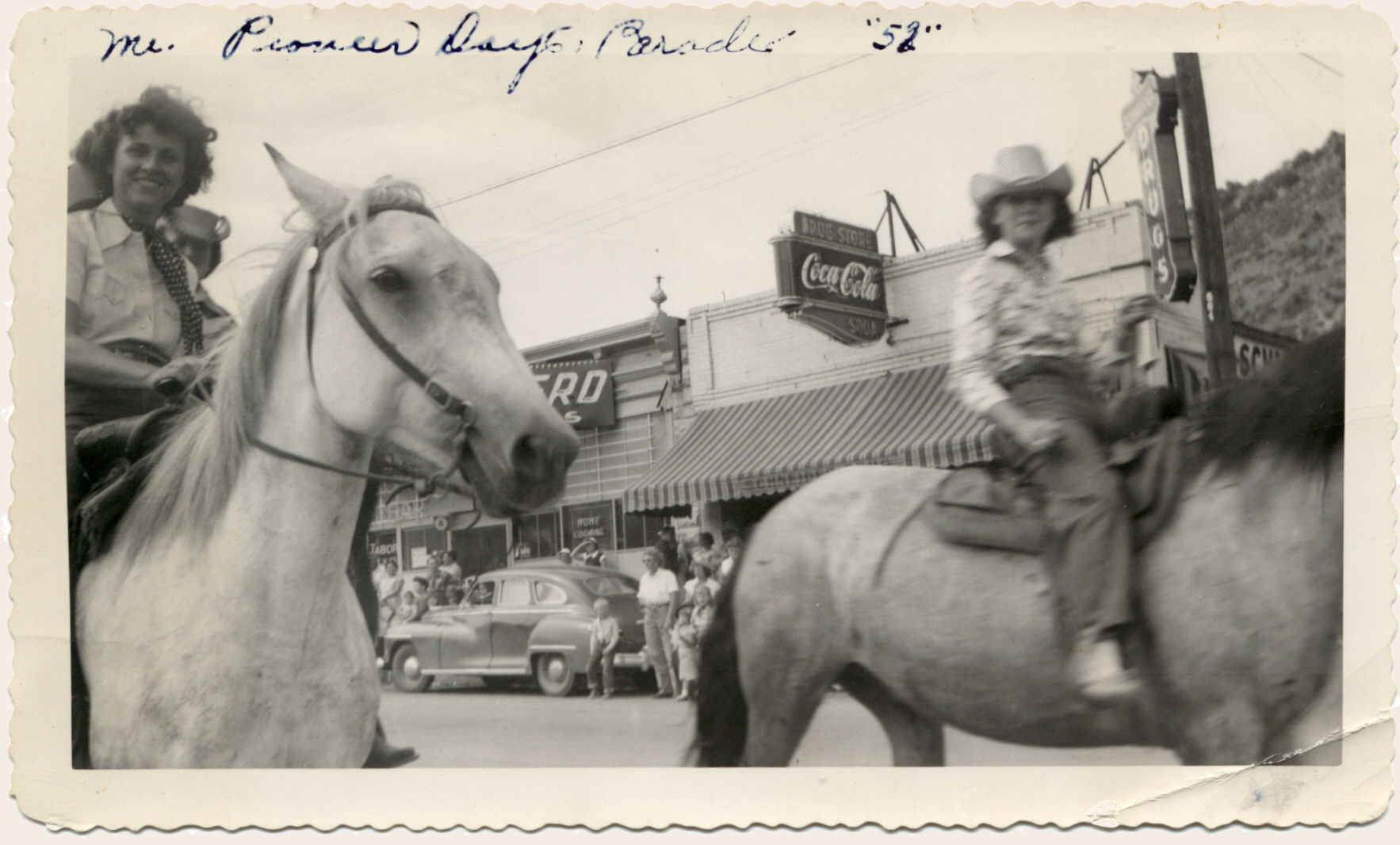
Pioneer Days were celebrated for more than a half-century in Morrison, and the parade down Bear Creek Avenue was especially popular. Stagecoach rides, showdowns, and visits to “jail” were other popular activities during the event.

Two young ladies riding in the Pioneer Days parade, 1952.

Morrison Walking Tour Map

In 1976, Lorene (Reenie) Horton and others completed an inventory of town historic buildings and submitted an application for designation of the Morrison Historical District to the National Register of Historic Places. They also published a walking tour brochure and a “Memory Album” booklet that contained photos collected from town residents. We are in the process of updating our “Places” listing with information from that project. Gradually, we’re getting more of Morrison’s historic sites online, some with more current photos.

We’ve kept the original numbering scheme for the town sites, of course, but be aware that some addresses have changed since 1976. In the 1990s, the fire department renumbered many properties, and we’ve not yet cross-referenced them here. This information is presented mostly as it was written in 1976, with a few comments on more current building uses for reference.

As you explore Morrison, keep in mind that, other than the downtown business district, most of these properties are private residences. Click to enlarge the map below.